







Week in Regulation
October 13, 2026
DHS Kicks Off October With Costly Proposed Rules
Federal agency activity during the first full week of October 2026 landed decidedly on the cost-adding side of the regulatory ledger. All told, there were 14 rulemakings that contained some kind of quantified economic impact. The most significant items of the bunch came in a pair of proposed rules from the Department of Homeland Security (DHS) – one adding a new fee schedule to certain student visas and the other on additional customs declaration requirements – with estimated costs well into the billions of dollars. Overall, federal agencies published roughly $40 billion in total costs and added 26.7 million paperwork burden hours.
REGULATORY TOPLINES
- Proposed Rules This Week: 42
- Final Rules This Week: 49
- 2026 Total Pages: 64,637
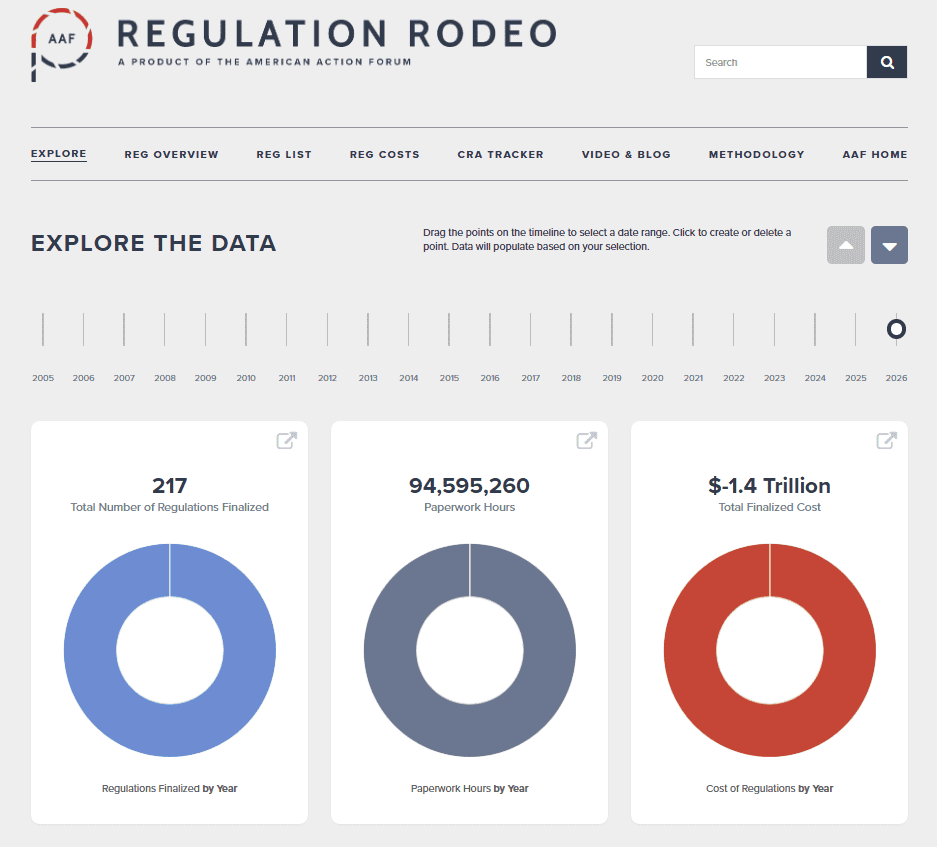
- 2026 Final Rule Costs: -$1.4 trillion
- 2026 Proposed Rule Costs: $85.7 billion
NOTABLE REGULATORY ACTIONS
The most consequential actions of the week were the two proposed rules from DHS regarding “Optional Practical Training (OPT) Fees” and “Low-Value Shipments,” respectively. The former would institute “The following fees…for each F-1 nonimmigrant student to engage in OPT through a Student and Exchange Visitor Program-certified institution: $70,000 for initial OPT; and $30,000 for any subsequent OPT.” The fee payments themselves would constitute transfer payments, but DHS also anticipates “opportunity costs from the lost OPT participation,” that could amount to $29 billion over a 10-year horizon. The latter proposal seeks “to amend the U.S. Customs and Border Protection regulations to modify filing requirements for informal entries of goods valued at $2,500 or less and to establish a new electronic informal entry type for merchandise entering through the mail environment.” Such changes would result in more stringent compliance and reporting requirements, yielding $7.7 billion in total new costs and nearly 24 million hours of additional paperwork each year.
TRACKING TRUMP 2.0
Last week, the American Action Forum (AAF) published an analysis of the Trump Administration’s progress in implementing the regulatory budget framework under Executive Order (EO) 14192 over the past year. The core findings were that:
Over the course of fiscal year (FY) 2026, federal agencies published 152 final rules under EO 14192 whose combined estimated economic effects represented nearly $1.5 trillion in total net regulatory cost reductions – bringing the administration’s overall to-date total to nearly $1.6 trillion. Despite that massive sum, a cursory look at some of the most significant rules still on the horizon suggests that – much as in the first Trump term – the administration may see diminishing returns in its deregulatory efforts going forward.
The two DHS proposed rules discussed above could quite plausibly become final by the end of FY 2027. As such, they represent additional examples of sizable cost-adding items that would contravene the administration’s heretofore deregulatory posture.
In assessing (calendar year) 2026 rulemakings that include an EO 14192 determination, there have been 79 “deregulatory” rules with combined total savings of $1.5 trillion against 15 “regulatory” rules that involve roughly $45.9 billion in costs. Adding that to the total agencies produced during 2025 (at least from rules that had a clear “regulatory” or “deregulatory” designation), the Trump Administration has enacted $1.6 trillion in total cost reductions thus far under EO 14192. Rules for which agencies have claimed one of the EO’s exemptions have accounted for an additional $7.1 billion in costs so far in 2026.
CONGRESSIONAL REVIEW ACT (CRA)
The AAF CRA tracker provides a full survey of activity under the law thus far into this term. As of today, members of the 119th Congress have introduced CRA resolutions of disapproval addressing 148 “rules” that collectively involve $175.5 billion in estimated compliance costs. Of these, 23 have been passed into law, repealing a series of Biden Administration rules that had a combined $3 billion in associated compliance costs. The Trump Administration estimates that the repeal of a Biden-era rule on air pollutants yields an additional $936 million in savings. While the main window of CRA action has largely passed, there are still outstanding resolutions that could move legislatively. AAF will continue to monitor and update such developments as appropriate.
TOTAL BURDENS
Since the start of 2026, the federal government has published $1.35 trillion in total regulatory net cost savings (with $1.4 trillion in reductions from finalized rules) and 149.8 million hours of net annual paperwork increases (with 94.6 million hours coming from final rules).