







Week in Regulation
November 23, 2026
Big Week for Burden Cuts
This past week was a rather active one in terms of the number of, and impact from, federal rulemakings. There were 17 actions gracing the pages of the Federal Register that had measurable economic effects. The week’s haul of rules clearly trended in the deregulatory direction. The main items included a Securities and Exchange Commission (SEC) proposal on executive compensation disclosure and a final rule from the Department of Health & Human Services (HHS) making assorted updates to regulatory provisions regarding the Health Insurance Portability and Accountability Act of 1996 (HIPAA). Overall, federal agencies published roughly $14.6 billion in total cost savings and cut 15.7 million paperwork burden hours.
REGULATORY TOPLINES
- Proposed Rules This Week: 36
- Final Rules This Week: 62
- 2026 Total Pages: 75,314
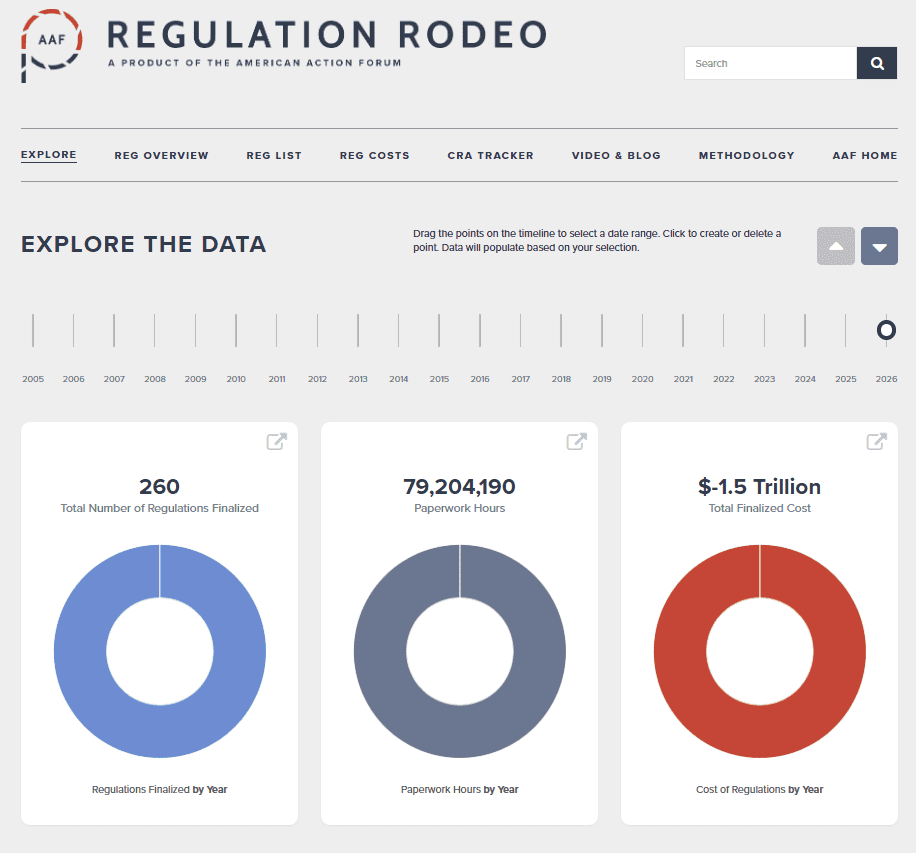
- 2026 Final Rule Costs: -$1.5 trillion
- 2026 Proposed Rule Costs: $37.7 billion
NOTABLE REGULATORY ACTIONS
The most economically significant rulemaking of the week was the SEC proposed rule on “Executive Compensation Disclosure Reform.” Specifically, the proposal:
Would focus the disclosures on the principal executive officer (“PEO”) and principal financial officer (“PFO”), streamline the tabular disclosure requirements, and simplify and rationalize various other aspects of the compensation disclosure rules, including the Compensation Discussion and Analysis (“CD&A”), pay ratio, pay-versus-performance, and perquisites disclosure requirements.
The commission expects these various changes to reduce the annual paperwork burden for affected entities by nearly 1.8 million hours. Given the relatively high per-response compensation rates involved in producing such disclosures, the commensurate total cost savings from the proposal net out to more than $11.3 billion across a 10-year horizon.
The other major cost-reducing action of the week was the final rule from HHS regarding “HIPAA Privacy Rule: Changes to Support Coordinated Care and Individual Engagement and Reduce Regulatory Burdens.” The primary focus of the rule is to amend “provisions of the Privacy Rule that may present barriers to individual engagement and care coordination and case management—or impose other burdens without sufficiently compensating for, or offsetting, such burdens through privacy protections for PHI [protected health information].” Notably, the proposed version was one of the final rulemakings promulgated under the first Trump term – although it didn’t technically hit the Federal Register until January 21, 2021, the first full day of the Biden Administration. The main quantified impact of this rule is a reduction of nearly 14.3 million paperwork burden hours and $546 million in commensurate compliance costs annually.
TRACKING TRUMP 2.0
In assessing (calendar year) 2026 rulemakings that include an Executive Order (EO) 14192 determination, there have been 91 “deregulatory” rules with combined total savings of $1.5 trillion against 18 “regulatory” rules that involve roughly $46.4 billion in costs. Adding that to the total agencies produced during 2025 (at least from rules that had a clear “regulatory” or “deregulatory” designation), the Trump Administration has enacted $1.6 trillion in total cost reductions thus far under EO 14192. Rules for which agencies have claimed one of the EO’s exemptions have accounted for an additional $7.7 billion in costs so far in 2026.
CONGRESSIONAL REVIEW ACT (CRA)
The AAF CRA tracker provides a full survey of activity under the law thus far into this term. As of today, members of the 119th Congress have introduced CRA resolutions of disapproval addressing 148 “rules” that collectively involve $175.5 billion in estimated compliance costs. Of these, 23 have been passed into law, repealing a series of Biden Administration rules that had a combined $3 billion in associated compliance costs. The Trump Administration estimates that the repeal of a Biden-era rule on air pollutants yields an additional $936 million in savings. While the main window of CRA action has largely passed, there are still outstanding resolutions that could move legislatively. AAF will continue to monitor and update such developments as appropriate.
TOTAL BURDENS
Since the start of 2026, the federal government has published $1.4 trillion in total regulatory net cost savings (with $1.5 trillion in reductions from finalized rules) and 160.6 million hours of net annual paperwork increases (with 79.2 million hours coming from final rules).