Week in Regulation
December 16, 2024
Busy Week Culminates with Interesting Cost “Adjustment”
This past week was an all-around barnburner in terms of regulatory activity. With two dozen rulemakings carrying some quantified economic effect, there was volume. With multiple rules north of $100 million in costs, there was impact. Perhaps the most interesting action of the week, however, was a Department of Homeland Security (DHS) rule that finalized a temporary rule from earlier this year regarding employment authorization for noncitizens. Across all rulemakings, agencies published $3.2 billion in total costs and added 10.2 million annual paperwork burden hours.
REGULATORY TOPLINES
- Proposed Rules: 44
- Final Rules: 100
- 2024 Total Pages: 101,344
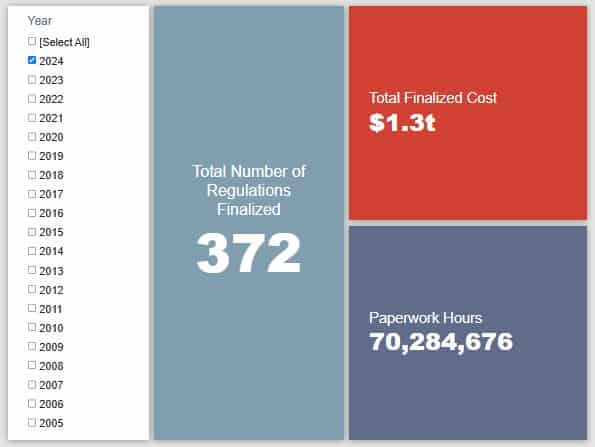
- 2024 Final Rule Costs: $1.3 trillion
- 2024 Proposed Rule Costs: $128.6 billion
NOTABLE REGULATORY ACTIONS
The most significant action of the week was the DHS rule regarding “Increase of the Automatic Extension Period of Employment Authorization and Documentation for Certain Employment Authorization Document Renewal Applicants.” This latest rulemaking permanently implements the changes made under a temporary rule from earlier this year. As the American Action Forum (AAF) noted at the time of the temporary rule, this extension of the employment authorization window has a range of potential impacts, but the clearest effect will be in reduced “labor turnover costs” – to the tune of $5.2 billion in total savings from that rule. This week’s permanent rule still finds savings in this regard, but after utilizing updated calculations, the agency now finds a lower level of such savings. To account for this net effect despite the substantive continuity, this rule counts as roughly $1.9 billion in “costs” for RegRodeo purposes.
The other major items of the week both came on the proposed rule side. The runner-up in terms of costs was a Department of Health and Human Services (HHS) rule making updates to various Medicare and Medicaid programs in “Contract Year 2026.” That rule included $72 million and 2.4 million hours in annual costs and paperwork, respectively. Extrapolating that annual cost figure out across the 10-year analytical period yields $647 million in total costs. The other main driver of this week’s paperwork trend was the proposed rule from the Consumer Financial Protection Bureau on “Protecting Americans From Harmful Data Broker Practices (Regulation V)” that will involve approximately 7.1 million hours of paperwork each year.
TRACKING THE ADMINISTRATIONS
As we have already seen from executive orders and memos, the Biden Administration has provided plenty of contrasts with the Trump Administration on the regulatory front. And while there have been areas where the current administration has sought to broadly restore Obama-esque regulatory actions, there are also areas where it has charted its own course. Since the AAF RegRodeo data extend back to 2005, it is possible to provide weekly updates on how the top-level trends of President Biden’s regulatory record track with those of his two most recent predecessors. The following table provides the cumulative totals of final rules containing some quantified economic impact from each administration through this point in their respective terms.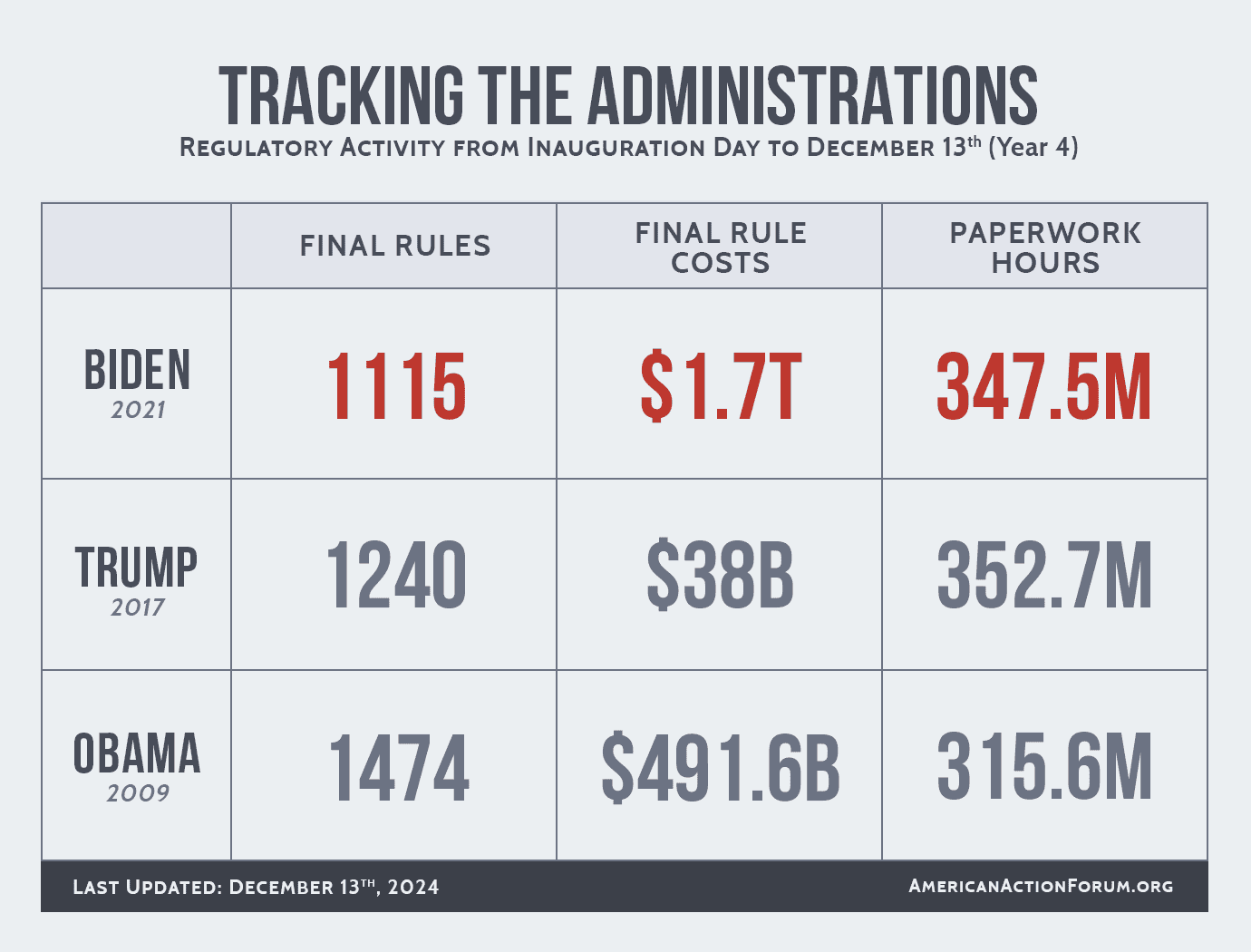 Over the course of the past week, Biden-era final rule costs and paperwork increased by $2.4 billion and roughly 630,000 hours, respectively. The employment authorization rule discussed above accounted for most of that cost trend. An HHS rule on pharmaceutical transactions made up most of the balance of the cost increase. As for the other administrations covered here, there was little on the Obama side, but the Trump era saw some interesting developments. In early December 2020, costs decreased by $635 million while paperwork increased by nearly 719,000 hours. A Department of Transportation rule was the main reason for the former, while a rule on asylum standards was the primary driver of the latter.
As the Biden Administration concludes, AAF will continue this analytical section for the remainder of its term to provide a complete historical record of its agency activity and how it stacked up against the full first terms of the other included administrations – even if the rulemakings finalized in these waning months may be subject to recission under the incoming administration and Congress. As noted during the campaign, there is little reason to believe this Trump Administration’s regulatory policy will be directionally different from that of its first term. Yet given that President-elect Trump now stands to join Grover Cleveland as the only president thus far to have a second non-consecutive term, the exact nature and format of this section may undergo some changes once that second term begins. Stay tuned.
TOTAL BURDENS
Since January 1, the federal government has published $1.48 trillion in total net costs (with $1.35 trillion in new costs from finalized rules) and 153.6 million hours of net annual paperwork burden increases (with 70.3 million hours coming from final rules).