Week in Regulation
June 23, 2025
Finally, a Whole Lot of Something
Loyal followers of the Week in Regulation have likely become accustomed to limited rulemaking news over recent weeks. One has to go back to mid-April to find a week that really moved the needle in that regard. Well, last week brought that trend to an abrupt end. Thanks primarily to a series of cross-cutting rulemakings from the Environmental Protection Agency (EPA) that carry economic effects pushing into the billions of dollars, the past week of regulation was a relative doozy. Across all rulemakings, agencies published $1.5 billion in total costs but cut 170,252 paperwork burden hours.
REGULATORY TOPLINES
- Proposed Rules: 47
- Final Rules: 43
- 2025 Total Pages: 26,358
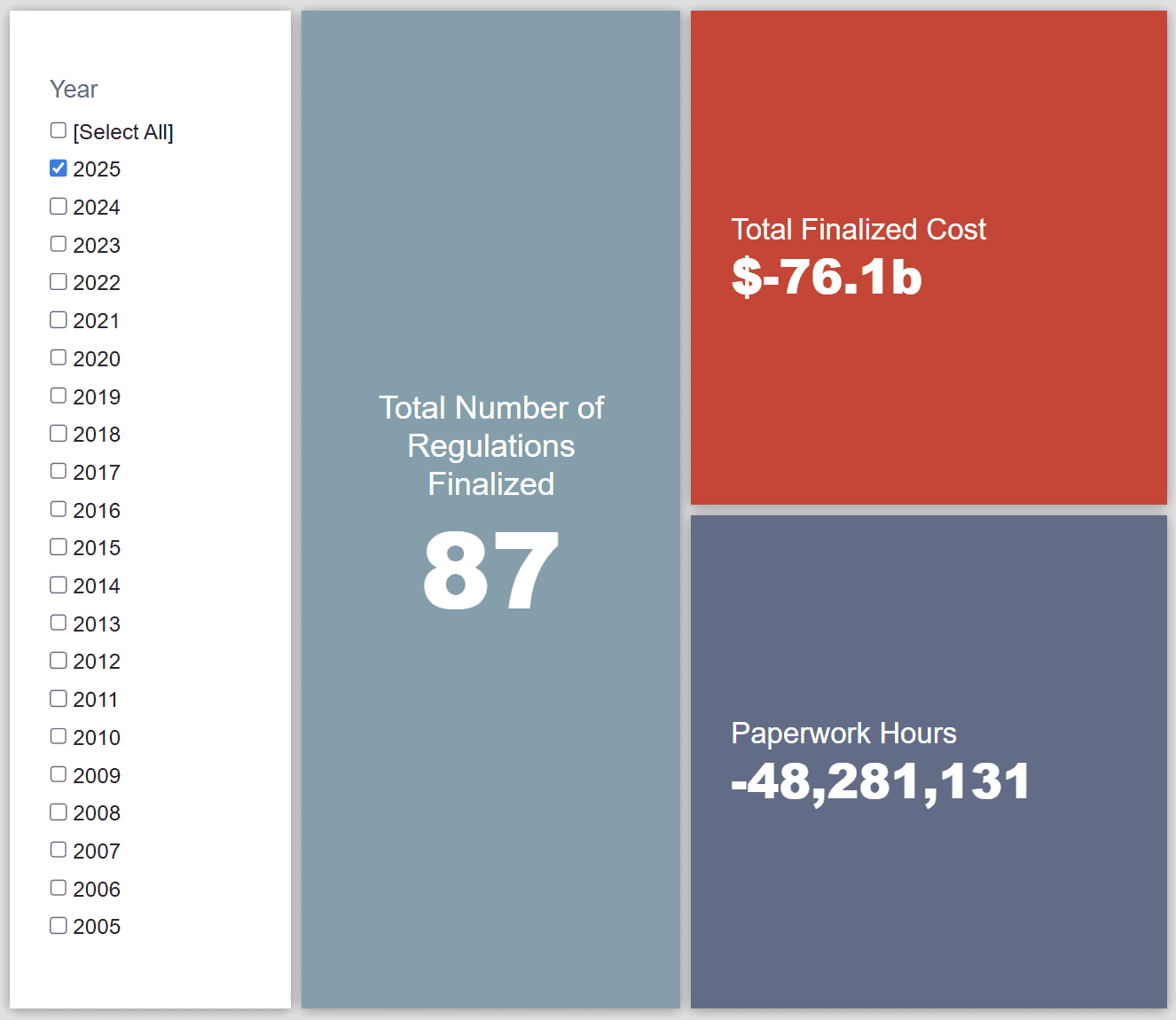
- 2025 Final Rule Costs: -$76.1 billion
- 2025 Proposed Rule Costs: $183.2 billion
NOTABLE REGULATORY ACTIONS
This past week saw some of the Trump Administration’s most significant deregulatory proposals finally hit the pages of the Federal Register in the form of proposed rules from EPA regarding “Repeal of Greenhouse Gas Emissions Standards for Fossil Fuel-Fired Electric Generating Units,” and “National Emission Standards for Hazardous Air Pollutants: Coal- and Oil-Fired Electric Utility Steam Generating Units.” The American Action Forum (AAF) examined the fuller implications of the proposals upon their initial, pre-Federal Register release here. EPA estimates that the combined cost savings afforded by these proposed rules will come to roughly $10.4 billion in present value terms using a 7-percent discount rate[1].
In terms of regulatory budgeting, however, the potential cost savings coming from the above deregulatory proposals were overshadowed by a regulatory action promulgated by EPA as well: the proposed rule on “Renewable Fuel Standard (RFS) Program: Standards for 2026 and 2027, Partial Waiver of 2025 Cellulosic Biofuel Volume Requirement, and Other Changes.” The proposal represents the latest round of adjustments under the two-decades-old RFS program. The most recent update before this one came in 2023 during the Biden Administration. As noted then and in the previous Trump Administration iteration, the program’s primary economic effect is to prop up certain, less cost-efficient fuel types at the expense of others, leading to net cost increases for consumers. Per EPA’s cost-benefit analysis, this latest tranche of standards comes to more than $12 billion in total costs. As such, EPA notes that this rulemaking “is expected to be an Executive Order 14192 regulatory action.”
TRACKING TRUMP 2.0
There were no significant, broad-based regulatory policy pronouncements from the administration this past week. The only action of any real note was President Trump signing a pair of Congressional Review Act (CRA) resolutions into law late Friday. With Congress – and the Senate in particular – firmly ensconced in figuring out the current reconciliation bill over coming weeks, it is highly doubtful there will be meaningful CRA developments any time soon.
Be sure to check the AAF CRA tracker. As of today, members of the 119th Congress have introduced CRA resolutions of disapproval addressing 45 Biden-era rules that collectively involve $138 billion in compliance costs. Out of these, 16 such resolutions have been passed into law, repealing a series of Biden Administration rules that had a combined $3 billion in associated compliance costs – roughly 2 percent of that potential $138 billion total. While the main window of CRA action has largely passed, since there are still outstanding resolutions that could move legislatively, AAF will continue to monitor and update such developments as appropriate.
TOTAL BURDENS
Since January 1, the federal government has published $107.1 billion in total net costs (with $76.1 billion in cost savings from finalized rules) and 69.6 million hours of net annual paperwork cuts (with 48.3 million hours coming from final rules).