Week in Regulation
March 17, 2025
Immigration Rule Brings First Real Costs of New Administration
As loyal followers of the Week in Regulation have surely noticed, the opening weeks of the Trump Administration’s return to power have seen a remarkably restrained flow of regulatory activity – even compared to some past administrations in their respective “regulatory freeze” periods. This past week, however, saw the first real deviation from that trend. A Department of Homeland Security (DHS) rule establishing further immigration registration requirements marks the first truly significant rulemaking from this administration that contains regulatory burdens. Across all rulemakings, agencies published $404.1 million in total costs and added 2.6 million paperwork burden hours.
REGULATORY TOPLINES
- Proposed Rules: 23
- Final Rules: 31
- 2025 Total Pages: 12,209
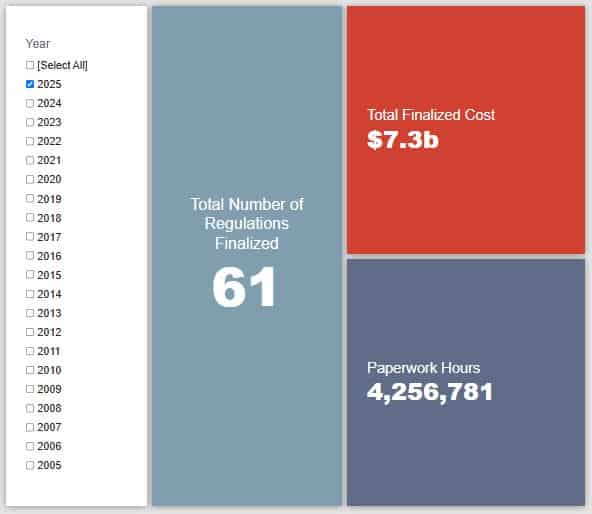
- 2025 Final Rule Costs: $7.3 billion
- 2025 Proposed Rule Costs: $180.2 billion
NOTABLE REGULATORY ACTIONS
Last Wednesday, DHS published an interim final rule (IFR) regarding “Alien Registration Form and Evidence of Registration.” The rule “amends DHS regulations to designate a new registration form for aliens to comply with statutory alien registration and fingerprinting provisions.” Per the rule’s Paperwork Reduction Act analysis, this new form would add an annual paperwork burden of 2,576,000 hours with an associated annual “opportunity cost” to those filing this paperwork of roughly $118 million (or $355 million total across the three-year window in which paperwork requirements are officially valid).
This represents the costliest rule that clearly emanates from the Trump Administration thus far in this term. The administration, however, deems it exempt from the president’s regulatory budget executive order since it involves a “national security, homeland security and the immigration-related function of the United States.” Furthermore, as an IFR, the rule skips over the proposed rule phase of the rulemaking process and goes into effect April 11.
TRACKING TRUMP 2.0
Perhaps the most significant Trump Administration regulatory policy news of the past week came late last Friday with the president signing into law two Congressional Review Act (CRA) resolutions of disapproval: H.J. Res 35 and S.J. Res 11. As noted in prior American Action Forum (AAF) Week in Regulation editions, each resolution made its way through Congress with relative ease. Their eventual passage into law was never really in doubt; the White House had clearly stated the administration’s position on each resolution. Nevertheless, these signatures now officially wipe two Biden-era rulemakings – with a combined $464.5 million in estimated total costs – off the board.
This past week also saw the following CRA resolution pass through at least one chamber of Congress:
HOUSE
- J. Res 25 (Passed 292-132)
Last Tuesday, the House passed H.J. Res 25 which seeks to repeal the Internal Revenue Service (IRS) rule regarding “Gross Proceeds Reporting by Brokers That Regularly Provide Services Effectuating Digital Asset Sales.” The resolution is the substantively the same as it Senate counterpart, S.J. Res 3, that had previously passed that chamber by a 70-27 vote. This effectively makes it the third CRA resolution on its way to the White House for President Trump’s signature – albeit with a bit a of constitutionally driven procedural twist.
Just prior to voting on H.J. Res 25, the House officially returned S.J. Res 3 to the Senate. Since the rulemaking in question comes from the IRS, it inherently pertains to federal revenue collection. Per the “origination clause” of the Constitution, all legislation on such matters must technically begin in the House of Representatives. Again, this likely represents a mere wrinkle in the legislative path of this CRA resolution. Barring some tremendous reversal from S.J. Res 3’s wide margin, the Senate will approve H.J. Res 25 sometime in the near future.
Be sure to follow the AAF updated CRA tracker. As of today, members of the 119th Congress have introduced CRA resolutions of disapproval addressing 38 Biden-era rules that collectively involve $137.5 billion in compliance costs. AAF will continue to update this tracker as additional resolutions are introduced and receive votes on the floors of each chamber.
TOTAL BURDENS
Since January 1, the federal government has published $187.5 billion in total net costs (with $7.3 billion in new costs from finalized rules[1]) and 22.4 million hours of net annual paperwork cuts. (with 4.3 million hours in increases from final rules).