Week in Regulation
March 10, 2025
A Spring Trend Emerges
Following along a similar track to the last week of February, the first week of March revealed a burgeoning trend that is likely to continue for the near future: relatively limited agency rulemaking but increasing action on the Congressional Review Act (CRA) front. There were seven rulemakings published that contained some kind of quantifiable economic impact – all of which were airworthiness directives. Meanwhile, there were five successful votes on CRA resolutions, with yet another set to head to President Trump for his expected signature. Across all rulemakings, agencies published $186.2 million in total costs and no new paperwork burden hours.
REGULATORY TOPLINES
- Proposed Rules: 20
- Final Rules: 45
- 2025 Total Pages: 11,563
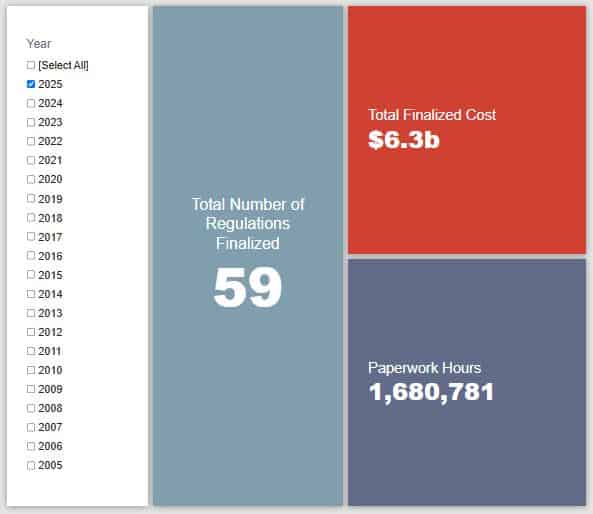
- 2025 Final Rule Costs: $6.3 billion
- 2025 Proposed Rule Costs: $180.1 billion
NOTABLE REGULATORY ACTIONS
As noted above, all the week’s rulemakings with appreciable cost effects came in the form of Federal Aviation Administration airworthiness directive rules. Notably, the most significant cohort of these all focused on repair requirements for various Boeing aircraft.
In a rulemaking-adjacent development this past week, the Department of Treasury (Treasury) announced that it will suspend enforcement of the “Beneficial Ownership” rule emanating from the Corporate Transparency Act. The rule involved quite significant compliance costs and has been the subject of various litigation battles and potential legislative changes over recent years. The Treasury sub-agency in charge of implementing the rule has announced that it will promulgate rulemakings later this month to formally extend and amend the compliance guidelines. It is not clear whether this action comes under the auspices of the recent executive order on enforcement discretion, but it does provide an example of what future actions of that nature could look like.
TRACKING TRUMP 2.0
This past week saw the following CRA resolutions pass through at least one chamber of Congress:
HOUSE
- J. Res 61 (Passed 216-202)
- J. Res 42 (Passed 222-203)
- J. Res 11 (Passed 221-202)
SENATE
- J. Res 3 (Passed 70-27)
- J. Res 28 (Passed 51-47)
With S.J. Res 11 (a resolution seeking to repeal a Department of Interior rule regarding “Protection of Marine Archaeological Resources”) passing through the House of Representatives, it now joins H.J. Res 35 from the preceding week as the second resolution that merely requires a presidential sign-off at this point. In terms of stated plans, the House appears poised to take up H.J. Res 25 – its version of S.J. Res 3 – this week, which would address an Internal Revenue Service rule regarding “Gross Proceeds Reporting by Brokers That Regularly Provide Services Effectuating Digital Asset Sales.”
Be sure to follow the American Action Forum’s (AAF) updated CRA tracker. As of today, members of the 119th Congress have introduced CRA resolutions of disapproval addressing 36 Biden-era rules that collectively involve $136.9 billion in compliance costs. AAF will continue to update this tracker as additional resolutions are introduced and receive votes on the floors of each chamber.
TOTAL BURDENS
Since January 1, the federal government has published $186.4 billion in total net costs (with $6.3 billion in new costs from finalized rules) and 25 million hours of net annual paperwork cuts (with 1.7 million hours in increases from final rules).