







Week in Regulation
May 5, 2025
A Marginally Cost-saving Week
This past week saw a slight uptick in the overall volume of rulemaking activity with a grand total of nine agency actions that had some kind of quantifiable economic impact. Most of these items, however, were not particularly significant. Driven primarily by a series of proposed rules from the Department of Health and Human Services (HHS), the week’s haul of rulemakings did come out as cost-reductive on net. Additionally, there was plenty of Congressional Review Act (CRA) news coming from the halls of Congress. Across all rulemakings, agencies published $56 million in total cost savings and cut 757,440 paperwork burden hours.
REGULATORY TOPLINES
- Proposed Rules: 19
- Final Rules: 28
- 2025 Total Pages: 18,865
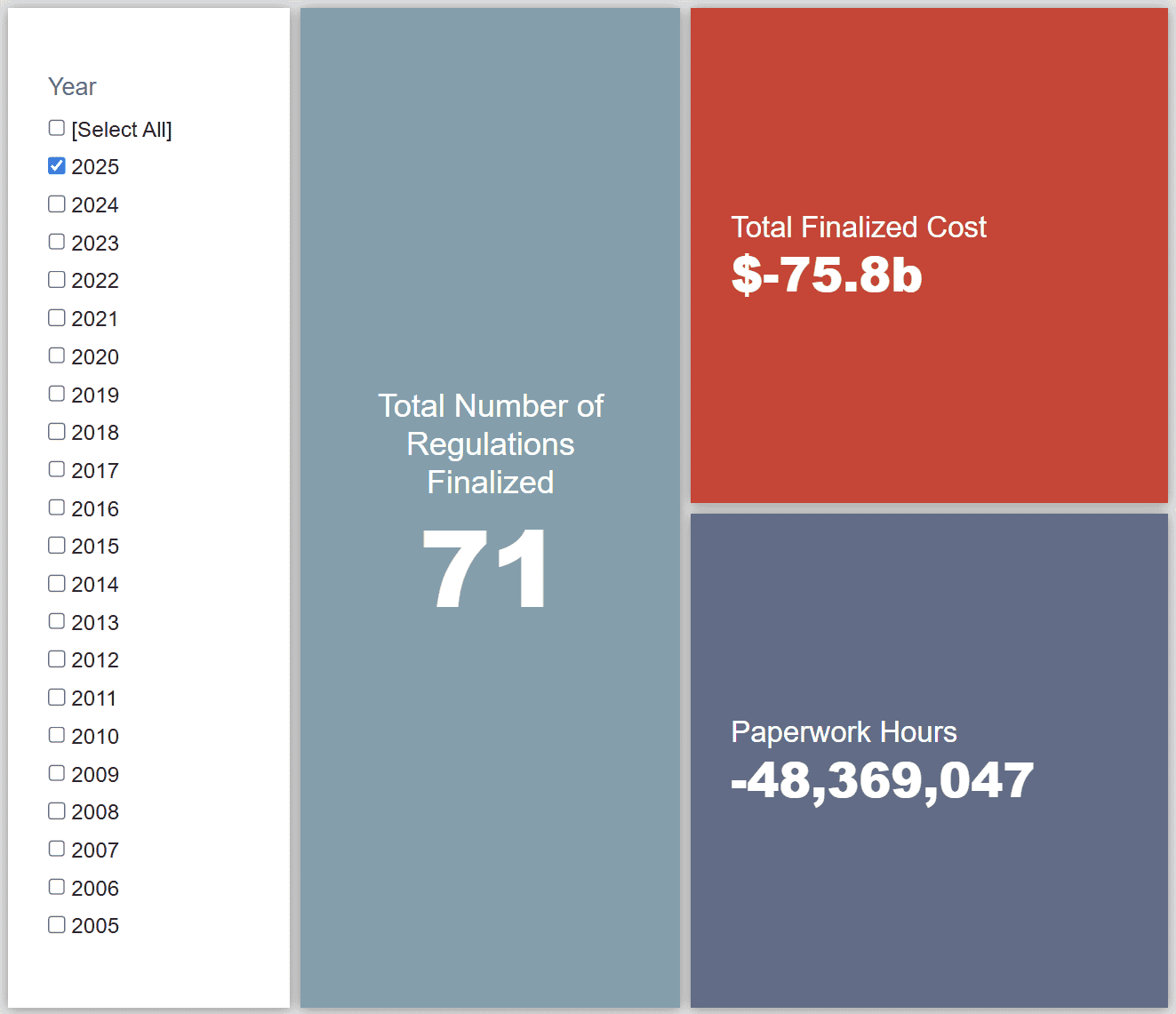
- 2025 Final Rule Costs: -$75.8 billion
- 2025 Proposed Rule Costs: $181.3 billion
NOTABLE REGULATORY ACTIONS
The most substantial rulemaking activity of the week came from a handful of HHS proposed rules published last Wednesday. Since these proposals were Medicare and Medicaid payment rules, much of their more consequential impact came from how they redirected relevant transfer payments. There were, however, some regulatory adjustments made that seek to produce some degree of burden reductions. The most significant of these was the proposal regarding “Hospital Inpatient Prospective Payment Systems for Acute Care Hospitals and the Long-Term Care Hospital Prospective Payment System and Policy Changes and Fiscal Year 2026 Rates; Requirements for Quality Programs; and Other Policy Changes,” which would decrease the annual paperwork burden by roughly 663,000 hours, bringing $18.2 million in annual monetized savings.
TRACKING TRUMP 2.0
There was, once again, not all that much to report in terms of general regulatory policy items from the administration. Many of the announcements emanating from the White House this past week focused on the president’s first “100 Days” back in office thus far. The main regulatory policy points highlighted in the administration’s memo celebrating the occasion were that the president has: 1) frozen all pending Biden-era proposed rulemakings, 2) begun implementation of the “10-to-1 deregulatory initiative,” and 3) “issued over 20 significant deregulatory presidential actions (i.e., executive orders, presidential memoranda, and presidential proclamations).”
Speaking of presidential actions, there was an executive order (EO) from last week that, while perhaps not terribly consequential in terms of significant economic policy impacts, nevertheless provides a conspicuous case study in the use of guidance memoranda to effectuate policy decisions. The EO, entitled “Enforcing Commonsense Rule of the Road for America’s Truck Drivers,” is essentially one manifestation of the administration’s broader “Designating English as the Official Language of the United States” policy. The EO directs the Department of Transportation to take a series of steps to ostensibly “ensure that anyone behind the wheel of a commercial vehicle is properly qualified and proficient in our national language, English.”
One of these actions is to rescind and update an Obama-era guidance document that, at its core, removed “the requirement to place drivers out of service for English Language Proficiency (ELP) violations and changes the Agency’s standard for determining non-compliance with the ELP requirements.” The memo goes on to address various minute details of the ELP certification process – policy verbiage that is likely only interesting to affected parties. This memo, and now this presumed Trump Administration revision to it, stand as examples, though, of documents setting regulatory policy that fall outside of the typical notice-and-comment rulemaking process. Also of note: The forthcoming Trump Administration edition of this memo will likely make the relevant ELP disciplinary criteria more stringent, thereby representing a more regulatory policy than the nominally deregulatory one established under the Obama-era memo.
Turning to Capitol Hill, it was a fairly busy week on the CRA front. The following resolutions of disapproval passed through at least one chamber of Congress:
HOUSE
- H.J. Res 60 (Passed 219-205)
- H.J. Res 78 (Passed 216-195)
- H.J. Res 87 (Passed 231-191)
- H.J. Res 88 (Passed 246-164)
- H.J. Res 89 (Passed 225-196)
SENATE
- H.J. Res 42 (Passed 52-46)
- H.J. Res 75 (Passed 52-45)
- S.J. Res 31 (Passed 52-46)
All five resolutions passed in the House now presumably head to the Senate for consideration. Among these are the set of CRA resolutions (H.J. Res 87, 88, & 89) addressing Clean Air Act (CAA) waiver determinations for California emissions standards that, as mentioned last week, face a somewhat uncertain fate in the upper body due to a dispute over whether the CRA applies to the underlying waiver decisions.
The Senate passed one resolution that now requires the House’s attention: S.J. Res 31, which would repeal an Environmental Protection Agency rule on CAA emissions standards for major stationary sources. The Senate also advanced a pair of resolutions that had previously passed the House: H.J Res 42 (addressing Department of Energy (DOE) energy efficiency certification procedures) and H.J. Res 75 (addressing DOE efficiency standards for commercial refrigerators and freezers).
These last two CRA resolutions join another four that have been passed by both chambers of Congress yet still await President Trump’s (expected) signature. Thus far, only three CRA resolutions have been signed into law. That makes nine total resolutions that have become law or will presumably become law sometime soon. The Biden-era rules these resolutions would repeal included roughly $2.9 billion in total estimated costs.
As the American Action Forum (AAF) has previously noted, this Congress likely has only about one week left to take up CRA resolutions on Biden Administration rules under the Act’s expedited procedure that allows the Senate to pass such resolutions with a simple majority. There do not currently appear to be any resolutions scheduled for consideration in the House this coming week. There are, however, still six House-passed resolutions that the Senate could take up if it so chooses.
Be sure to follow the AAF updated CRA tracker. As of today, members of the 119th Congress have introduced CRA resolutions of disapproval addressing 43 Biden-era rules that collectively involve $137.5 billion in compliance costs. AAF will continue to update this tracker as additional resolutions are introduced and receive votes on the floors of each chamber.
TOTAL BURDENS
Since January 1, the federal government has published $105.5 billion in total net costs (with $75.8 billion in cost savings from finalized rules) and 69.5 million hours of net annual paperwork cuts (with 48.4 million hours coming from final rules).