Week in Regulation
August 18, 2025
Regulations Take a Vacation
Federal agencies seemed to take a cue from Congress and much of the public at large and take a bit of an August break – at least as it relates to anything of any real significance. While there was a relatively steady flow of routine and mundane regulatory documents in the pages of the Federal Register, only one rulemaking contained measurable costs. That action, an airworthiness directive from the Federal Aviation Administration (FAA), was quite rote itself. Across all rulemakings, agencies published roughly $165,000 in total costs and no changes in paperwork burden hours.
REGULATORY TOPLINES
- Proposed Rules: 18
- Final Rules: 44
- 2025 Total Pages: 39,941
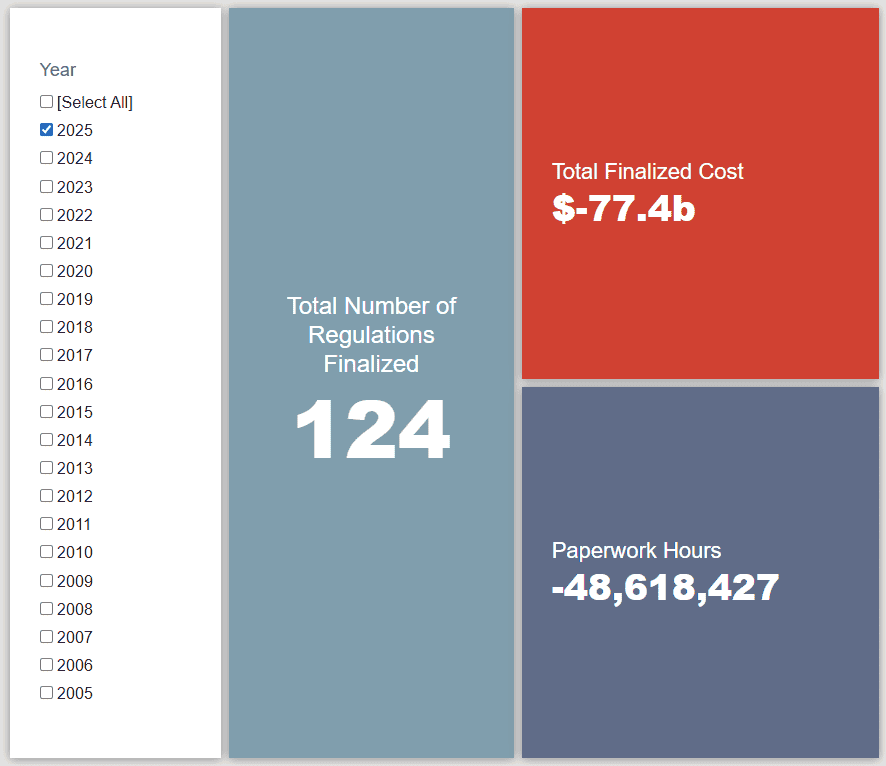
- 2025 Final Rule Costs: -$77.4 billion
- 2025 Proposed Rule Costs: -$627.2 billion
NOTABLE REGULATORY ACTIONS
As mentioned above, the only rule with a recordable economic impact attached to it was an FAA airworthiness directive focused on addressing structural issues in certain Airbus aircraft that carries a whopping $165,000 in estimated required costs.
TRACKING TRUMP 2.0
The only policy announcement out of the White House that would have some kind of rulemaking implications was the president’s executive order (EO) on “Enabling Competition in the Commercial Space Industry.” The EO’s main policy aim is the following:
It is the policy of the United States to enhance American greatness in space by enabling a competitive launch marketplace and substantially increasing commercial space launch cadence and novel space activities by 2030. To accomplish this, the Federal Government will streamline commercial license and permit approvals for United States-based operators.
To this end, the EO more specifically directs relevant agencies to:
- Review and update the regulatory and permitting barriers to commercial launch operations as well as those constraining further construction of spaceport infrastructure;
- Reassess the “process for individualized mission authorizations for activities that are covered by Article VI of the Outer Space Treaty of 1967, but not clearly or straightforwardly governed by existing regulatory frameworks;” and
- Establish senior positions within overall agency structure that are directly responsible for commercial space operations policy.
With Congress out for its August Recess, Congressional Review Act (CRA) news remains at a standstill. Nevertheless, the American Action Forum (AAF) CRA tracker provides a full survey of activity under the law thus far in 2025. As of today, members of the 119th Congress have introduced CRA resolutions of disapproval addressing 57 rulemakings across the Biden and Trump Administrations that collectively involve $138 billion in compliance costs. Of these, 16 have been passed into law, repealing a series of Biden Administration rules that had a combined $3 billion in associated compliance costs – roughly 2 percent of that potential $138 billion total. While the main window of CRA action has largely passed, there are still outstanding resolutions that could move legislatively. AAF will continue to monitor and update such developments as appropriate.
TOTAL BURDENS
Since January 1, the federal government has published $704.7 billion in total regulatory net cost savings (with $77.4 billion in cost savings from finalized rules) and 70.9 million hours of net annual paperwork cuts (with 48.6 million hours coming from final rules).