Week in Regulation
August 25, 2025
Swine Slaughter Proposed Rule Leads the Week
This past week of regulatory action was relatively quiet, although not nearly the nothing-burger that was the week that preceded it. If anything, it was more of a pulled pork sandwich kind of week. That is to say, across the nine rulemakings with some kind of measurable economic impact, the only one that really stood out was a Department of Agriculture (USDA) proposed rule seeking to update certain regulatory provisions regarding swine slaughter procedures. Across all rulemakings, agencies published roughly $123.3 million in total cost savings and cut 41,973 paperwork burden hours.
REGULATORY TOPLINES
- Proposed Rules: 52
- Final Rules: 54
- 2025 Total Pages: 41,193
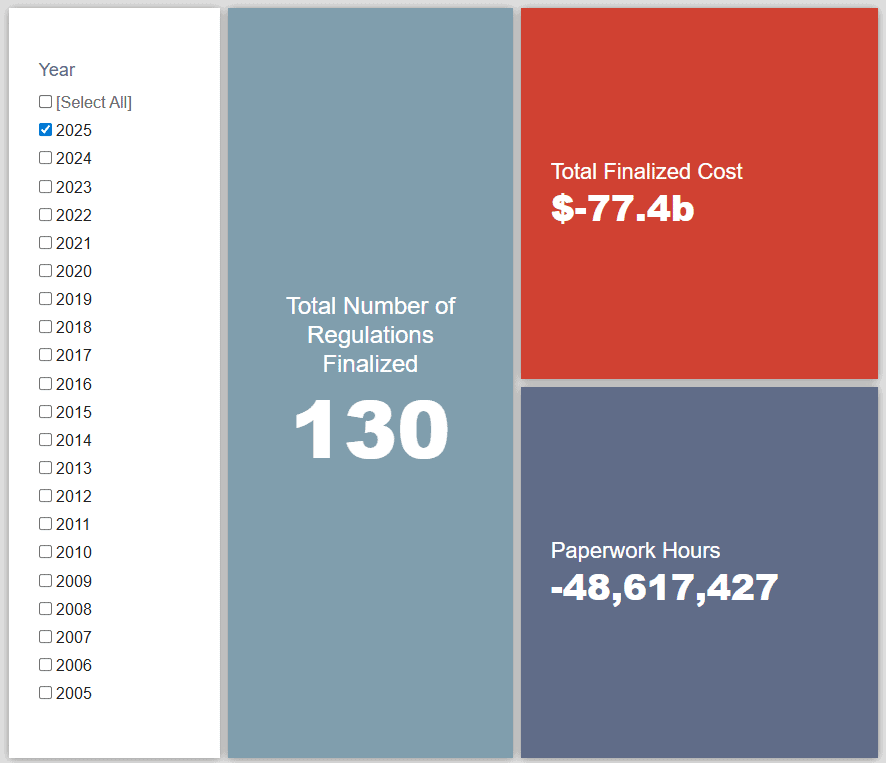
- 2025 Final Rule Costs: -$77.4 billion
- 2025 Proposed Rule Costs: -$627.4 billion
NOTABLE REGULATORY ACTIONS
As mentioned above, the most substantial item of the week was the USDA (or, more specifically, the Food Safety and Inspection Service (FSIS)) proposal regarding “Visual Post-Mortem Inspection in Swine Slaughter Establishments.” The agency summarizes the proposed rule’s main aims thus:
FSIS is proposing to end mandatory mandibular lymph nodes incision and viscera palpation of swine carcasses in all swine slaughter establishments (i.e., establishments operating under traditional swine slaughter inspection or the New Swine Slaughter Inspection System (NSIS). Mandibular lymph nodes (“lymph nodes”) incision and viscera palpation of swine carcasses are not needed to ensure food safety, as FSIS swine condemnation rates are low and disease conditions that are condemnable defects can be detected visually through other pathological changes in the carcass and its parts. Therefore, FSIS is proposing to amend the meat inspection regulations to remove requirements for establishment sorters to “incise mandibular lymph nodes and palpate the viscera” as part of their sorting activities before FSIS post-mortem inspection in NSIS establishments.
Apologies if any of that confused you and/or diminished your appetite just now. Overall, though, USDA expects these changes to “reduc[e] the number of employees needed to make carcasses and parts ready for inspection because the workload for sorters may be reduced.” The agency estimates that this will yield “annual industry cost savings…from approximately $14.7 to $25.4 million over 10 years discounted at 7 percent.” Taking the midpoint of that estimate and projecting it out across that 10-year horizon would mean roughly $141 million in total cost savings.
TRACKING TRUMP 2.0
There were no broad-based policy announcements from the White House last week that had any significant rulemaking implications.
With Congress out for its August Recess, Congressional Review Act (CRA) news remains at a standstill. Nevertheless, the American Action Forum (AAF) CRA tracker provides a full survey of activity under the law thus far in 2025. As of today, members of the 119th Congress have introduced CRA resolutions of disapproval addressing 57 rulemakings across the Biden and Trump Administrations that collectively involve $138 billion in compliance costs. Of these, 16 have been passed into law, repealing a series of Biden Administration rules that had a combined $3 billion in associated compliance costs – roughly 2 percent of that potential $138 billion total. While the main window of CRA action has largely passed, there are still outstanding resolutions that could move legislatively. AAF will continue to monitor and update such developments as appropriate.
TOTAL BURDENS
Since January 1, the federal government has published $704.8 billion in total regulatory net cost savings (with $77.4 billion in cost savings from finalized rules) and 71 million hours of net annual paperwork cuts (with 48.6 million hours coming from final rules).