Week in Regulation
March 24, 2025
The First Billion-dollar Trump Rulemaking
In terms of the volume of regulatory activity, this past week remained a relatively sparse one. There were only four rulemakings with some kind of quantifiable economic impact. At least one of them, however, left a mark. A proposed rule from the Department of Health and Human Services (HHS) regarding the health insurance exchanges brings costs north of $1 billion, making it the costliest rulemaking attributable to President Trump’s second term thus far. Across all rulemakings, agencies published $1.2 billion in total costs and added 6.2 million paperwork burden hours.
REGULATORY TOPLINES
- Proposed Rules: 2.7
- Final Rules: 60
- 2025 Total Pages: 13,380
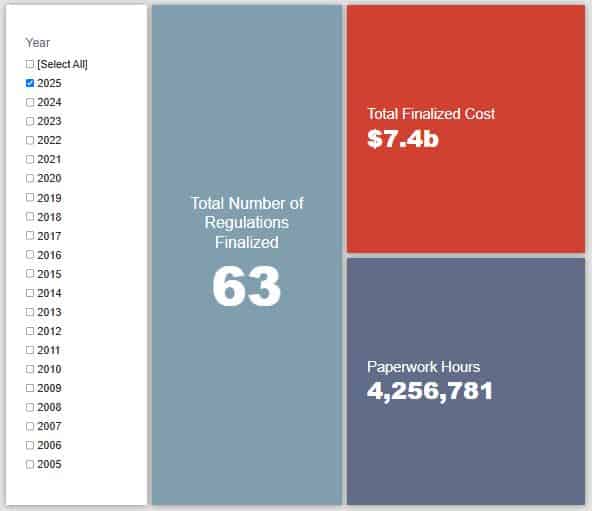
- 2025 Final Rule Costs: $7.3 billion
- 2025 Proposed Rule Costs: $181.3 billion
NOTABLE REGULATORY ACTIONS
As mentioned above, the most consequential rulemaking action of the week was the proposed rule from HHS regarding “Patient Protection and Affordable Care Act; Marketplace Integrity and Affordability.” The proposal:
Would revise standards relating to past-due premium payments; exclude Deferred Action for Childhood Arrivals recipients from the definition of “lawfully present”; the evidentiary standard HHS uses to assess an agent’s, broker’s, or web-broker’s potential noncompliance; failure to file and reconcile; income eligibility verifications for premium tax credits and cost-sharing reductions; annual eligibility redetermination; the automatic reenrollment hierarchy; the annual open enrollment period; special enrollment periods; de minimis thresholds for the actuarial value for plans subject to essential health benefits (EHB) requirements and for income-based cost-sharing reduction plan variations; and the premium adjustment percentage methodology; and prohibit issuers of coverage subject to EHB requirements from providing coverage for sex-trait modification as an EHB.
HHS estimates that these various changes will add up to $276 million in annual costs against roughly $600,000 in cost-saving benefits. Projecting these annualized estimates out across the five-year analytical window the agency utilizes yields $1.1 billion in total net costs. As such, it is hardly a surprise that, if finalized as proposed, the agency designates this as a “regulatory action,” under Executive Order (EO) 14192 – the administration’s updated regulatory budget program. Presumably HHS will now need to promulgate at least 10 deregulatory actions with savings that match or exceed this action’s costs to stay in the putative good graces of that EO’s directives.
TRACKING TRUMP 2.0
The most significant item of the week – at least on paper – in terms of the broader administrative state was President Trump’s issuing of an EO that seeks to close down the Department of Education (ED). Shuttering an entire cabinet-level agency would indeed be a dramatic policy action. It is, however, unclear what the timeline of such an exercise would look like merely under the auspices of this EO. There may be some significant near-term internal reorganization of the agency, but fully unwinding ED as a formal entity requires legislation. Between the 60-vote threshold in the Senate and the rather narrow House Republican majority, the prospects of such legislation are quite dim.
With both chambers of Congress out this past week, there were no new developments on the Congressional Review Act (CRA) front. There are signs, however, that lawmakers will be taking up more resolutions of disapproval under the CRA this coming week. For instance, the House is poised to address a set of CRA resolutions targeting Department of Energy efficiency standards rules.
Be sure to follow the American Action Forum’s (AAF) updated CRA tracker. As of today, members of the 119th Congress have introduced CRA resolutions of disapproval addressing 38 Biden-era rules that collectively involve $137.5 billion in compliance costs. AAF will continue to update this tracker as additional resolutions are introduced and receive votes on the floors of each chamber.
TOTAL BURDENS
Since January 1, the federal government has published $188.7 billion in total net costs (with $7.3 billion in new costs from finalized rules) and 16.2 million hours of net annual paperwork cuts. (with 4.3 million hours in increases from final rules).