Week in Regulation
December 30, 2024
The Holiday Weeks in Regulation
With the federal holiday shortening last week to only three workdays, this edition of the Week in Regulation represents a “holiday special” of sorts, covering the past two weeks in one go. Agencies left plenty of presents under the Federal Register tree. There were 31 rulemakings with some kind of quantifiable economic impact. All but six of those were final rules, suggesting the Biden Administration is now firmly in its “midnight regulation” period. The Departments of Agriculture (USDA) and Energy (DOE), as well as the Environmental Protection Agency (EPA), were the standout agencies during this time. Across all rulemakings, agencies published $5.5 billion in total costs and added 7.2 million annual paperwork burden hours.
REGULATORY TOPLINES
- Proposed Rules: 73
- Final Rules: 173
- 2024 Total Pages: 106,106
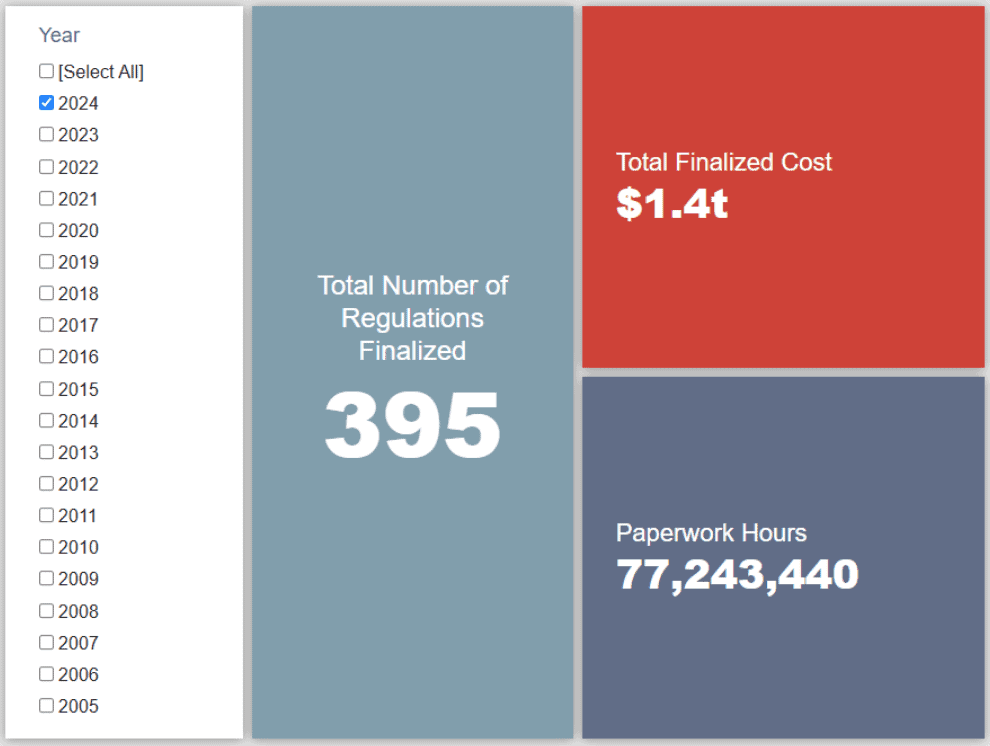
- 2024 Final Rule Costs: $1.35 trillion
- 2024 Proposed Rule Costs: $128.8 billion
NOTABLE REGULATORY ACTIONS
EPA saw the most consequential set of actions come down the line over these past two weeks. All told, the agency had seven rulemakings that added up to roughly $2.9 billion in costs and nearly 700,000 hours of paperwork. The bulk of these totals came from a series of rules under the auspices of the Toxic Substances Control Act regarding the regulation of the following chemicals: trichloroethylene, perchloroethylene, and carbon tetrachloride.
DOE and USDA claimed second and third place for economic impact over these weeks, respectively. DOE promulgated a pair of significant energy efficiency standards covering Walk-in Coolers and Walk-in Freezers and Consumer Gas-fired Instantaneous Water Heaters that had a combined cost total of roughly $1.8 billion. Meanwhile, USDA put forward its final rule implementing “three provisions of the Fiscal Responsibility Act (FRA) of 2023, affecting the program purpose and individuals subject to the able-bodied adults without dependents (ABAWD) time limit for the Supplemental Nutrition Assistance Program (SNAP).” The rule’s new requirements will result in $642 million in administrative costs to state agencies and individuals with roughly 4.5 million hours of new paperwork annually.
TRACKING THE ADMINISTRATIONS
As we have already seen from executive orders and memos, the Biden Administration will surely provide plenty of contrasts with the Trump Administration on the regulatory front. And while there is a general expectation that the current administration will seek to broadly restore Obama-esque regulatory actions, there will also be areas where it charts its own course. Since the AAF RegRodeo data extend back to 2005, it is possible to provide weekly updates on how the top-level trends of President Biden’s regulatory record track with those of his two most recent predecessors. The following table provides the cumulative totals of final rules containing some quantified economic impact from each administration through this point in their respective terms.
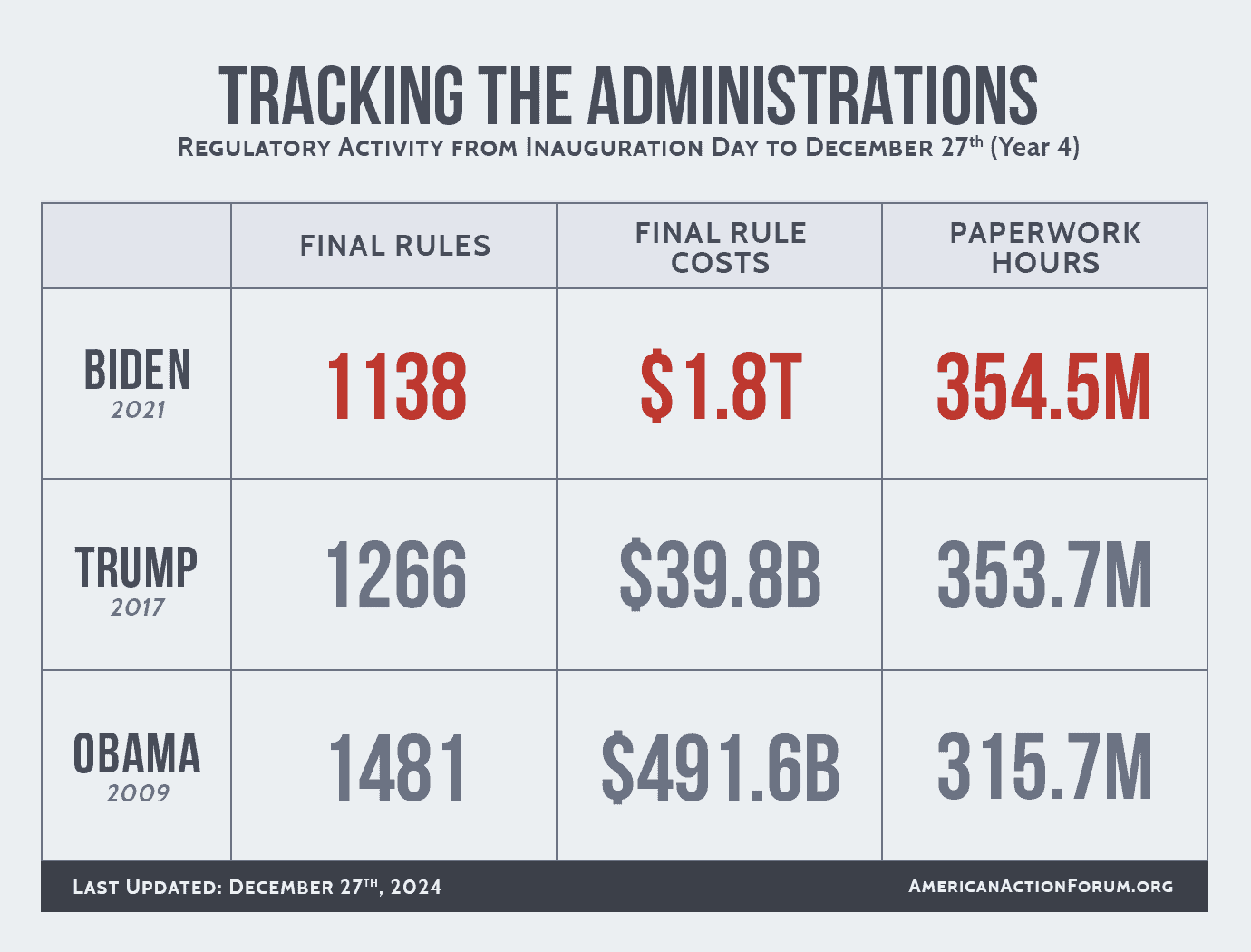
Given this level of rulemaking over the past couple of weeks, it is no surprise that the Biden Administration’s totals continued to grow as the end of the current president’s term approaches. Final costs increased by roughly $5.3 billion – pushing the Biden-era total past the $1.8 trillion threshold – while paperwork increased by 7 million hours, thereby reclaiming the “lead” from the Trump Administration in that category. For its part, the Trump Administration also saw some noticeable bumps: $1.8 billion in costs and nearly one million hours of paperwork. The Trump-era Department of Labor rule on investment advice and a Securities and Exchange Commission rule on certain kinds of derivatives were the main drivers of those increases. There was, however, virtually no movement in the Obama Administration totals.
As the Biden Administration concludes, AAF will continue this analytical section for the remainder of its term to provide a complete historical record of its agency activity and how it stacked up against the full first terms of the other included administrations – even if the rulemakings finalized in these waning months may be subject to recission under the incoming administration and Congress. As noted during the campaign, there is little reason to believe this Trump Administration’s regulatory policy will be directionally different from that of its first term. Yet given that President-elect Trump now stands to join Grover Cleveland as the only president thus far to have a second non-consecutive term, the exact nature and format of this section may undergo some changes once that second term begins. Stay tuned.
TOTAL BURDENS
Since January 1, the federal government has published $1.48 trillion in total net costs (with $1.35 trillion in new costs from finalized rules) and 160.8 million hours of net annual paperwork burden increases (with 77.2 million hours coming from final rules).