The Shipment
February 6, 2025
The Tariff Tango
TARIFFS!
What’s Happening: If last week’s tariff threat against Colombia was a shot heard around the world, this week’s tariffs (both delayed and implemented) are an entire volley. On February 1, President Trump issued executive orders that would impose tariffs of 25 percent on Mexico, 25 percent on Canada (10 percent on oil), and 10 percent on China as soon as February 4. As the Shipment predicted on January 30, Trump used the International Emergency Economic Powers Act (IEEPA) for the first time to impose these tariffs, citing national emergencies surrounding the fentanyl crisis and illegal immigration. In response to the tariff announcement, each affected trading partner vowed to impose retaliatory measures against the United States, yet at the same time continued to speak with Trump in the hopes of avoiding full-scale economic warfare. President Sheinbaum of Mexico agreed to send 10,000 national guard troops to help deal with illegal immigration and drug trafficking in exchange for delaying the tariffs for a month. Prime Minister Trudeau of Canada also reached an agreement to delay tariffs in exchange for a $1.3 billion border security plan, 10,000 officers deployed to monitor the border, the Canadian designation of the Mexican cartels as terror groups, the creation of a fentanyl czar, a joint strike force with the United States, and a $200 million investment in combating organized crime. As for China, 10 percent tariffs went into effect at midnight on February 4, which were met with immediate retaliation from China.
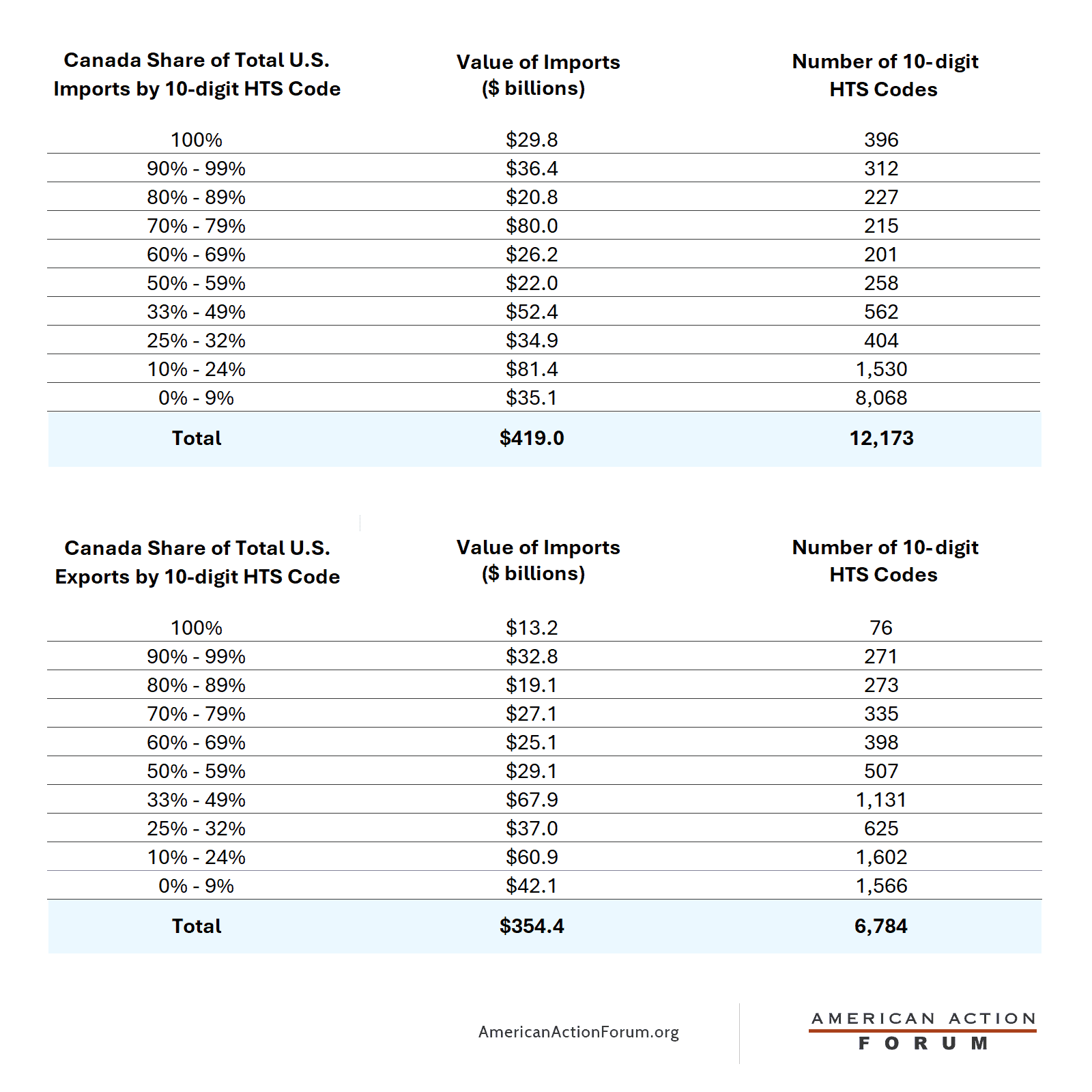
Why It Matters: Mexico, Canada, and China are the United States’ top three trade partners, accounting for roughly 43 percent of all U.S. imports and about 41 percent of all exports. While Mexico and Canada are safe from U.S. tariffs (for now), the tariff announcements sent shockwaves through international markets and supply chains that will continue to play out over the long term. For instance, an entire campaign to “buy Canadian” was established in Canada almost overnight, which was coupled with some provinces’ decision to remove American alcohol from state-run stores. While American products will likely be put back in stores, angered Canadians may change the purchasing preference of one of the largest U.S. export markets. The near-miss trade war also shed light on the fact that there are billions of dollars’ worth of goods that are solely imported from or exported to both Canada and Mexico (see figures below). The 10-percent tariffs the United States levied on China will raise costs for U.S. businesses and consumers either directly or through China’s retaliatory measures, which include tariffs on select U.S. exports, mineral restrictions, and actions against U.S. companies. According to the Shipment’s calculations, U.S. tariffs on China may cost consumers between $25–40 billion annually depending upon the degree of tariff evasion and how much of the price hike is passed through. Costs will likely skew toward the high end as all de minimis shipments from China, which avoid fees and tariffs, will now be subject to Section 301 tariffs as well as more intense screening. Current de minimis shipments from China will generate at least $5 billion in additional costs, require a large-scale increase in investment in Customs and Border Protection, and lead to additional processing fees, raising per-shipment costs by roughly 29 percent (medium estimate).
Looking Ahead: While President Trump was expected to speak with President Xi Jinping of China on Tuesday, February 4, the two leaders did not meet, and Trump told reporters he was in “no rush” to do so. China announced its retaliatory measures on February 4, but they will not take effect until February 10, leaving time for negotiations to take place. China will impose 15-percent tariffs on U.S. coal and natural gas as well as 10-percent tariffs on U.S. oil, agricultural equipment, pickup trucks, and large-engine cars. Non-tariff measures include export controls on tungsten materials (80 percent of which is produced in China), an antitrust probe into Google, the addition of two U.S. companies to China’s list of unreliable entities, and potentially a probe into Apple. Each of these actions on their own would have significant supply chain and market reactions. Those hoping the terror of tariffs ends with China shouldn’t hold their breath. Trump has already said that the European Union will likely face 10-percent tariffs and top Trump trade advisor Peter Navarro suggested that a universal tariff may still be on the table. Also buried by recent news are Trump’s threats of tariffs on specific industries and products – including pharmaceuticals, semiconductors, oil, steel, aluminum, and copper – that may come as soon as February 18. In short, be ready for a tariff roller coaster ride. a tariff roller coaster ride.
Graphic Explanation
These charts display the value of U.S. imports from and exports to Mexico and Canada by how reliant the United States is on those countries. For example, 92 different U.S. imports valued at $9.5 billion are sourced 100 percent from Mexico. Additionally, 190 U.S. imports worth nearly $38.5 billion are sourced between 90—99 percent from Mexico. Furthermore, 75 U.S. exports valued at $900 million are 100 percent exported to Mexico. This analysis used 2023 Dataweb import and export data with 10-digit HTS codes.