Week in Regulation
December 9, 2024
A Generally Quiet Week Rocked by One Major Revelation
The billion-dollar week streak is over. Sort of. Overall, this past week was relatively tepid, with 10 rulemakings that had some kind of quantified economic impact. None of these exceeded the $100-million mark in terms of costs, however. The key item of the week was a Department of Commerce (DOC) rule that largely affirmed an interim rule finalized on the last day of the original Trump Administration that inadvertently uncovers significant – and previously unaccounted-for – costs from the first Trump term. Across all rulemakings, agencies published $66.4 million in total costs and added 302,801 annual paperwork burden hours.
REGULATORY TOPLINES
- Proposed Rules: 29
- Final Rules: 74
- 2024 Total Pages: 97,342
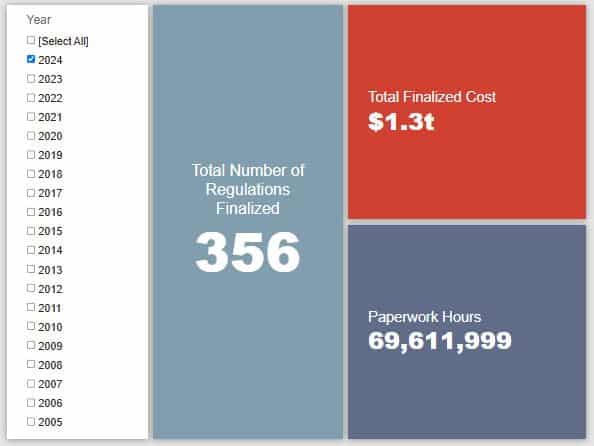
- 2024 Final Rule Costs: $1.35 trillion
- 2024 Proposed Rule Costs: $127.8 billion
NOTABLE REGULATORY ACTIONS
The main action of the week was the DOC rule regarding “Securing the Information and Communications Technology and Services Supply Chain.” The rule is not necessarily consequential in and of itself, however, as it is merely a finalized version of a January 19, 2021, interim final rule (IFR):
Establishing procedures for its review of transactions involving information and communications technology and services (ICTS) designed, developed, manufactured, or supplied by persons owned by, controlled by, or subject to the jurisdiction or direction of a foreign adversary that may pose undue or unacceptable risk to the United States or U.S. persons.
This original IFR – and an earlier proposed version – claimed an exemption from the Trump-era regulatory budget analysis citing national security concerns. Thus, the typical cost-benefit analysis was not included in the portion of the rule where one generally expects such analyses. A Regulatory Impact Analysis (RIA) for the rule eventually landed in the rulemaking docket, but not until roughly one month after the rule’s publication. As such, the American Action Forum (AAF) was unable to record and properly attribute the involved costs to the Trump Administration’s overall tally in RegRodeo at the time.
This turns out to have been a substantial omission. Per the calculations from the RIA found in the course of examining this Biden-era rule, DOC’s primary estimate for the IFR’s costs comes out to roughly $10.2 billion in annualized terms. Extrapolating that estimate out across the 10-year analytical window yields $71.9 billion in total present value costs. For perspective, the previously understood AAF Trump-era total was $40.4 billion in costs. Thus, this rule represents a near tripling of that total now. While this is clearly a sizable increase, the updated Trump total at $112.3 billion is still far lower than the $493.6 billion first-term Obama total and the roughly $1.8 trillion (see below) promulgated thus far under the Biden Administration.
TRACKING THE ADMINISTRATIONS
As we have already seen from executive orders and memos, the Biden Administration has provided plenty of contrasts with the Trump Administration on the regulatory front. And while there have been areas where the current administration has sought to broadly restore Obama-esque regulatory actions, there are also areas where it has charted its own course. Since the AAF RegRodeo data extend back to 2005, it is possible to provide weekly updates on how the top-level trends of President Biden’s regulatory record track with those of his two most recent predecessors. The following table provides the cumulative totals of final rules containing some quantified economic impact from each administration through this point in their respective terms.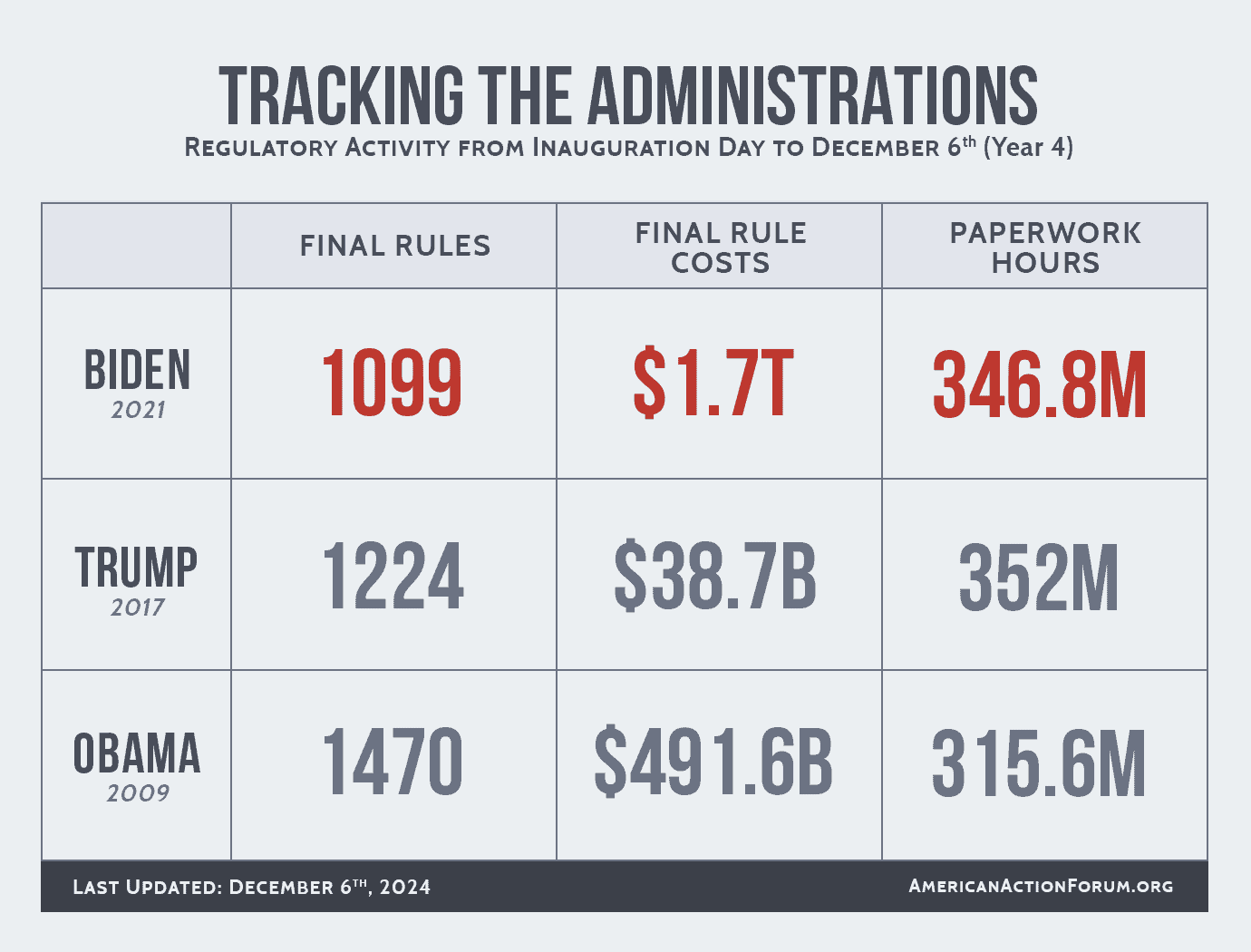 The Biden Administration to-date final rule totals rose only modestly with increases of $63.1 million and roughly 256,000 hours in costs and paperwork, respectively. The Trump-era ICTS rule discussed above will not register in that count until, quite literally, the end of the term in question. Nevertheless, a significant Department of Health and Human Services rule on pharmaceuticals combined with a deregulatory measure from the Environmental Protection Agency to produce roughly $700 million in net costs increases during early December 2020. The Obama Administration, however, saw the largest shift in its paperwork column with an FCC action regarding “Lifeline and Link Up Reform and Modernization,” bringing roughly 24 million hours of paperwork.
As the Biden Administration concludes, AAF will continue this analytical section for the remainder of its term to provide a complete historical record of its agency activity and how it stacked up against the full first terms of the other included administrations – even if the rulemakings finalized in these waning months may be subject to recission under the incoming administration and Congress. As noted during the campaign, there is little reason to believe this Trump Administration’s regulatory policy will be directionally different from that of its first term. Yet given that President-elect Trump now stands to join Grover Cleveland as the only president thus far to have a second non-consecutive term, the exact nature and format of this section may undergo some changes once that second term begins. Stay tuned.
TOTAL BURDENS
Since January 1, the federal government has published $1.48 trillion in total net costs (with $1.35 trillion in new costs from finalized rules) and 143.4 million hours of net annual paperwork burden increases (with 69.6 million hours coming from final rules).