Week in Regulation
January 21, 2025
The Final Week of Biden
This past week marked the final days of the Biden Administration. And it certainly went out in style on the regulatory front. There were a whopping 35 rulemakings that contained some kind of measurable economic impact. Rulemakings from the Food and Drug Administration (FDA) and Federal Acquisition Regulators (FAR – a joint venture of the Department of Defense, General Services Administration, and National Aeronautics and Space Administration) all had associated costs well into the billions of dollars. The most significant actions, however, were all proposed rules whose futures now ultimately lie in the hands of the returning Trump Administration. Across all rulemakings, agencies published $77 billion in total costs and added 3.2 million annual paperwork burden hours.
REGULATORY TOPLINES
- Proposed Rules: 78
- Final Rules: 143
- 2025 Total Pages: 6,769
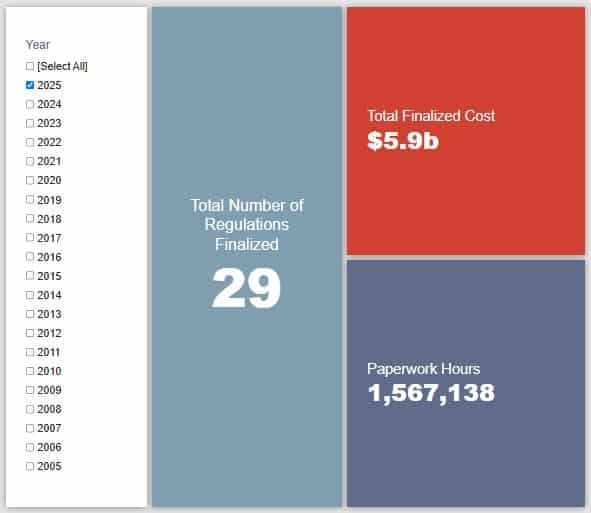
- 2025 Final Rule Costs: $5.9 billion
- 2025 Proposed Rule Costs: $107.7 billion
NOTABLE REGULATORY ACTIONS
The most active agency of the week was the FDA with a pair of proposed rules on “Tobacco Product Standard for Nicotine Yield of Cigarettes and Certain Other Combusted Tobacco Products” and “Food Labeling: Front-of-Package Nutrition Information.” The first proposal “would establish a maximum level of nicotine in cigarettes and certain other combusted tobacco products.” As one may expect, such an action would have a seismic impact on the tobacco product industry. The rulemaking’s analysis illustrates its magnitude with the agency estimating $58 billion in costs to attain $30.6 trillion in health benefits over a 40-year time horizon.
The second proposal is not nearly as consequential but would still carry substantial impacts. As the title suggests, the rulemaking would “require front-of-package nutrition labels on most foods that must bear a Nutrition Facts label.” FDA estimates that the costs involved for affected entities would come out to roughly $3.1 billion total over a 10-year period with qualitative health benefits “from the value consumers receive from the information provided in the interpretive label on food packages.”
The other notable rulemaking of the week came in the form of the FAR proposed rule on “Federal Acquisition Regulation: Controlled Unclassified Information.” The proposal would extend a series of information security standards to certain federal contractors that work with sensitive, yet technically unclassified, information and documents. The relevant agencies estimate that such new requirements would involve nearly $15.9 billion in costs for affected entities over a 10-year window.
TRACKING THE ADMINISTRATIONS
As we have seen from executive orders and memos, the Biden Administration provided plenty of contrasts with the Trump Administration – both past and future – on the regulatory front. And while there were areas where the Biden Administration sought to broadly restore Obama-esque regulatory actions, there were also areas where it charted its own course. Since the AAF RegRodeo data extend back to 2005, it is possible to provide weekly updates on how the top-level trends of President Biden’s regulatory record track with those of his two most recent predecessors. The following table provides the cumulative totals of final rules containing some quantified economic impact from each administration. Given that this was the final week of the Biden Administration, the following tally represents the final totals of each administration’s first term.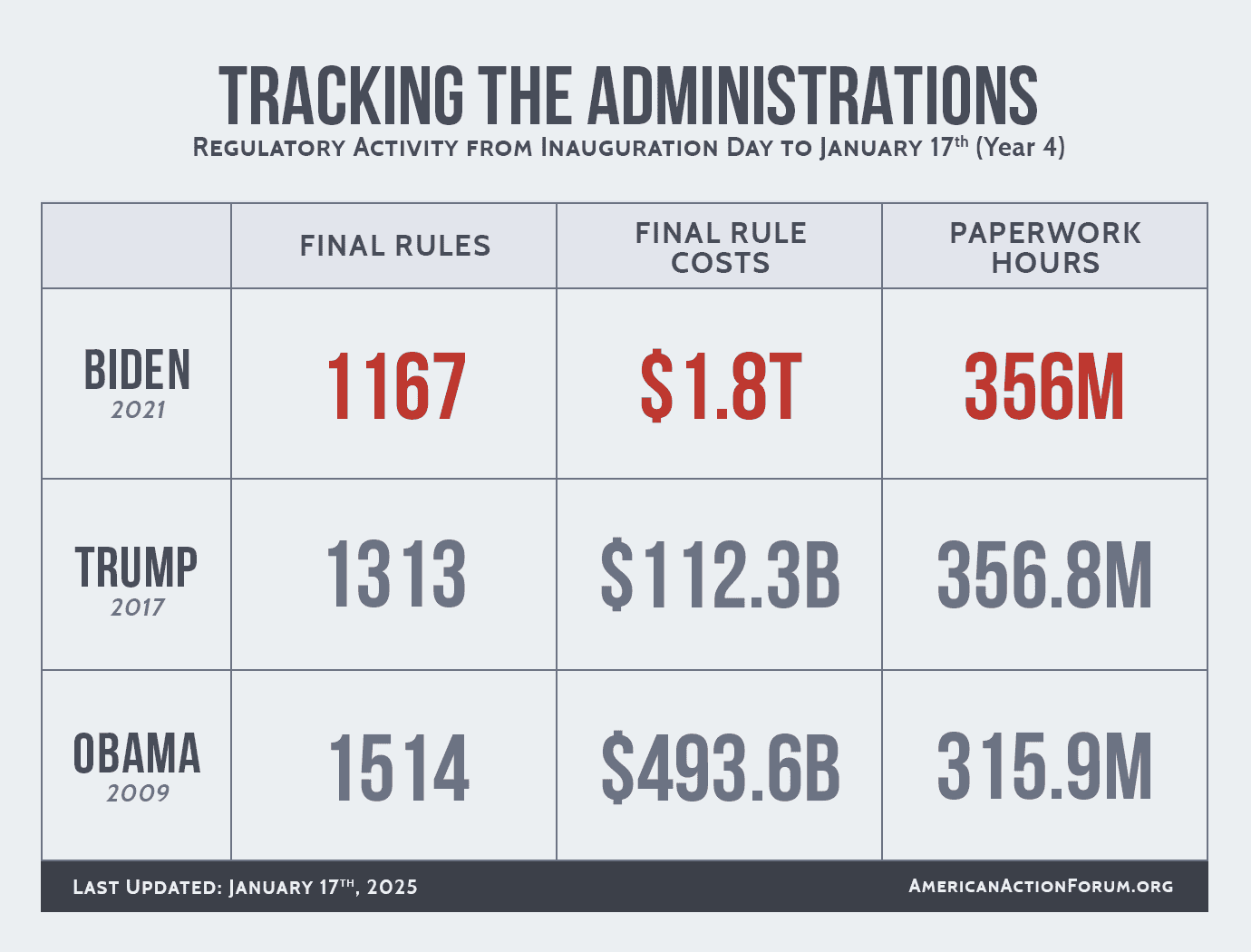 Much of the Biden Administration’s final week of regulatory action came on the proposed rule side of the ledger. As such, there were not necessarily any massive shifts in its ultimate final rule totals. The most significant final rule posted last week was a Department of Homeland Security measure on “Cybersecurity in the Marine Transportation System” that brought roughly $1.2 billion in total costs to affected industries. The outgoing administration finishes its term with just over $1.8 trillion in total estimated regulatory costs and 356.1 million hours of paperwork associated with its final rules.
The most notable shift actually came in the final tally for the first Trump term. As AAF discussed with regards to a Biden-era rule from last month, a rule on supply chain information security standards published on January 19, 2021 (the final day of the first Trump term) carried a belatedly revealed $72 billion in costs that caused the Trump-era cost total to surge to more than $112 billion. Additionally, the Trump Administration’s first term paperwork total ended up narrowly ahead of the Biden total by roughly 800,000 hours. Although, as AAF has noted before, a substantial amount of that first Trump term paperwork total was associated with relatively short-lived requirements regarding the COVID-19 pandemic.
Meanwhile, the Obama Administration rounded out its first term with $493.6 billion in total costs and nearly 316 million hours of paperwork. The final weeks of Obama’s first term saw relatively modest final rule shifts. This was likely a function of the simple fact that, of the three terms covered here, that administration knew that it was heading into a second term and thus did not have to rush out its remaining priorities at the time.
On that note, as of this week and going forward, Donald Trump is once again president. On his first day back in office, President Trump issued executive orders freezing all pending regulatory activity and rescinding a series of Biden executive orders – standard operating procedure during changes in administrations. It remains to be seen, however, exactly what the coming days and weeks of administrative policy – such as the re-implementation of the “regulatory budget” framework – will hold. As details become clearer, AAF will work to further contextualize the Trump 2.0 regulatory (or deregulatory) agenda. Stay tuned.
TOTAL BURDENS
Since January 1, the federal government has published $113.6 billion in total net costs (with $5.9 billion in new costs from finalized rules) and 25.2 million hours of net annual paperwork cuts (with 1.6 million hours in increases from final rules).