Insight
January 9, 2026
2025: The Year in Regulation
EXECUTIVE SUMMARY
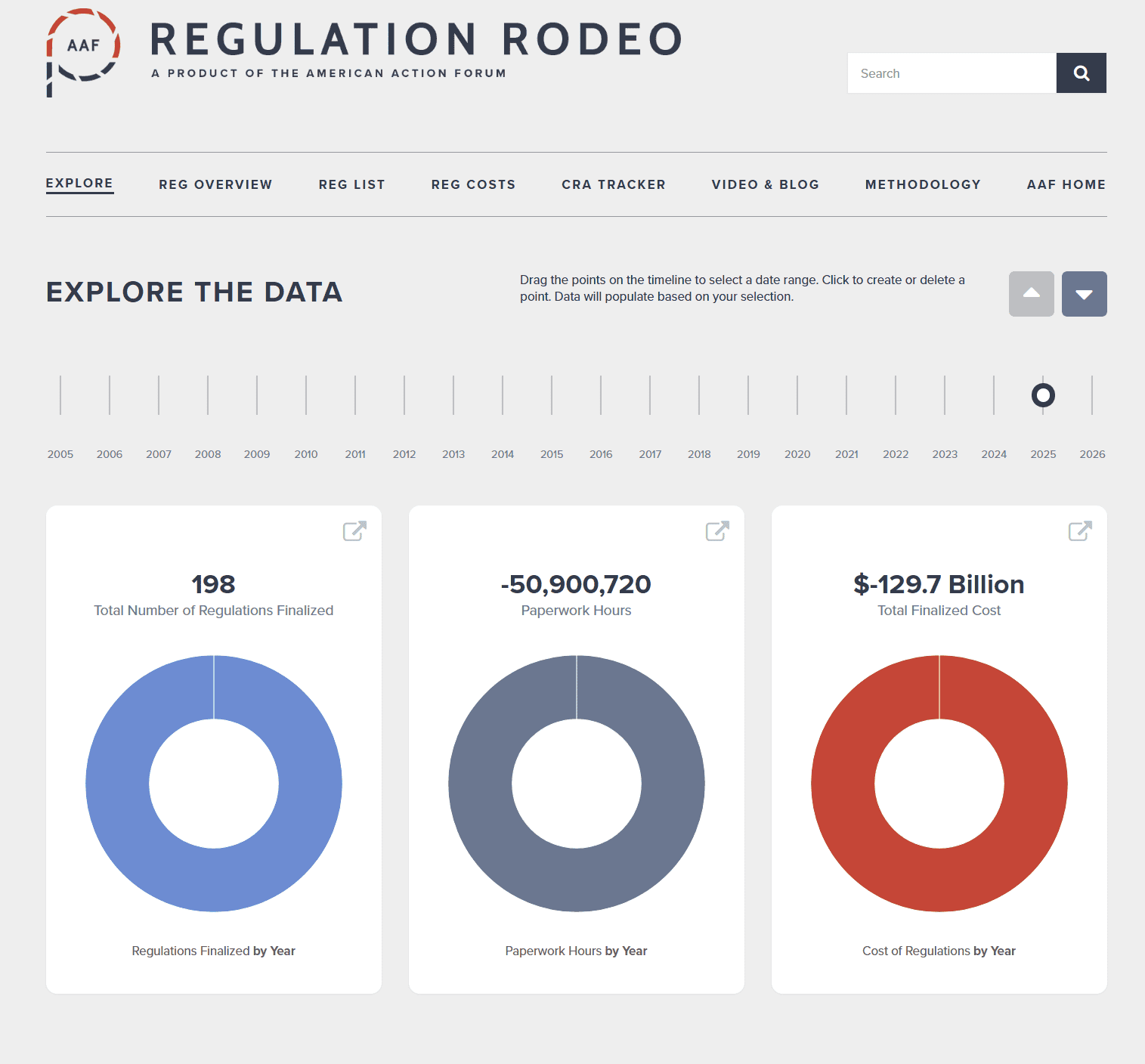
- Federal agencies collectively finalized $129.7 billion in net regulatory cost savings and 50.9 million hours in paperwork reductions in 2025, making it the most deregulatory calendar year recorded in RegRodeo.
- While only two actions accounted for most of those totals, the renewed regulatory budget program under Executive Order (EO) 14192 largely constrained new costs; that EO and proposed rulemakings currently under development are set to bring even more dramatic cost reductions over the next year or so.
- The first year of the second Trump term also brought a nearly unprecedented level of EOs and an aggressive push to re-orient typical regulatory procedures – the implications of which remain largely unknown.
INTRODUCTION
The change-over in administrations, even just across a single year, could not be more apparent. In 2024, federal agencies under the Biden Administration had the costliest year of regulations on record. In 2025, with the return of the Trump Administration’s deregulatory agenda under Executive Order (EO) 14192, federal agencies had the highest level to-date of regulatory cost reductions. Final rules accounted for nearly $130 billion in net savings (and nearly 60 million hours annually in paperwork reductions) while $4 billion in additional reductions came from Biden-era rules repealed under the Congressional Review Act (CRA), with hundreds of billions more still in the offing from currently proposed rules. A deeper examination reveals, however, that much of that final rule total is attributable to just two rulemakings. Nevertheless, this past year in regulation – or rather, deregulation – lays claim to a significant record. There’s also plenty to suggest the current administration is poised to make even more profound changes to the administrative state in the coming year.
SNAPSHOT OF FINAL RULES WITH ESTIMATED ECONOMIC IMPACTS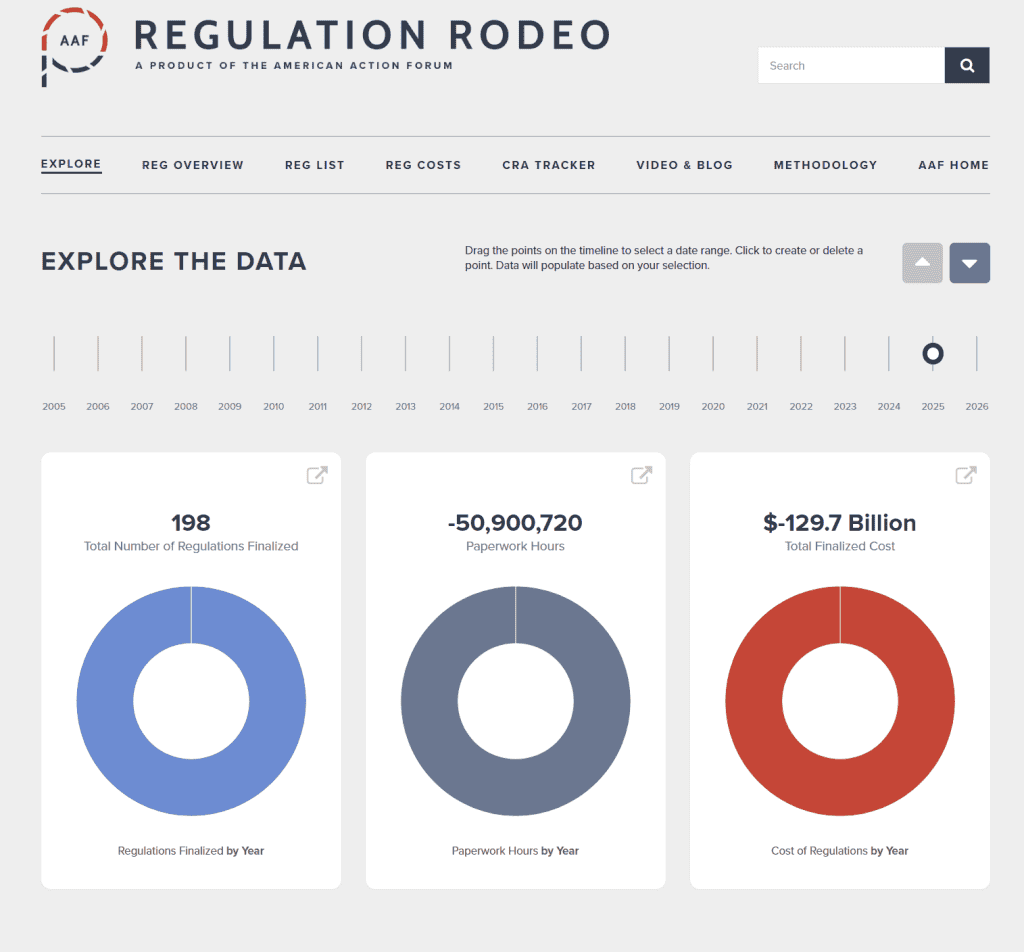
MOST SIGNIFICANT FINAL RULES OF THE YEAR
The following tables include the top five final rules published this past year across a series of categories:
Top 5 Costliest Rules
| Agency | Rule | Cost ($ billions) |
| Justice | Preventing Access to U.S. Sensitive Personal Data and Government-Related Data by Countries of Concern or Covered Persons | 4.1* |
| Environmental Protection Agency | Water Quality Standards To Protect Aquatic Life in the Delaware River | 2.3 |
| Homeland Security | Cybersecurity in the Marine Transportation System | 1.2* |
| Homeland Security | Enhanced Air Cargo Advance Screening (ACAS) | 0.9 |
| Health & Human Services | Medicare and Medicaid Programs; Contract Year 2026 Policy and Technical Changes to the Medicare Advantage Program, Medicare Prescription Drug Benefit Program, Medicare Cost Plan Program, and Programs of All-Inclusive Care for the Elderly | 0.8 |
Top 5 Cost-cutting Rules
| Agency | Rule | Savings ($ billions) |
| Treasury | Beneficial Ownership Information Reporting Requirement Revision and Deadline Extension | -84.0 |
| Health & Human Services | Medicare and Medicaid Programs; Repeal of Minimum Staffing Standards for Long-Term Care Facilities | -55.1 |
| Environmental Protection Agency | Effluent Limitations Guidelines and Standards for the Steam Electric Power Generating Point Source Category-Deadline Extensions | -1.4 |
| Environmental Protection Agency | Extension of Deadlines in Standards of Performance for New, Reconstructed, and Modified Sources and Emissions Guidelines for Existing Sources: Oil and Natural Gas Sector Climate Review Final Rule | -1.4 |
| Health & Human Services | Medicare Program; FY 2026 Inpatient Psychiatric Facilities Prospective Payment System-Rate Update | -0.3 |
*Denotes Biden Administration rule
The main conclusions to draw from the above rules are that 2025: A) saw relatively restrained new burden-adding rules, and B) had a cost-cutting topline largely propped up by two very significant rulemakings. The top five costliest rules add up to roughly $9.3 billion in overall costs. This represents roughly two-thirds of the total from all cost-additive final rules for the year: approximately $14 billion. For historical context, per RegRodeo data, the only calendar years with lower net totals than $14 billion were 2018 (the only other net-deregulatory year), 2005, and 2006. As such, the impact of final regulatory actions this past year was relatively restrained.
The cost-cutting top five is largely dominated by two rulemakings: the roll-back of the beneficial ownership rule and the effective repeal of the long-term care rule. The American Action Forum (AAF) covered the further implications of each here and here, respectively. Note that without these two rules, 2025 would clock in at roughly $9.4 billion in net total costs across all final regulatory and deregulatory rules. Even taking into account the cost reductions from CRA repeals (see below), this past year would have still been net-regulatory if not for these two specific rules.
CONGRESSIONAL REVIEW ACT
The past year also saw some significant developments under the Congressional Review Act, the law that allows a new Congress and administration to repeal certain rules issued by the preceding administration via an expedited process. As of year’s end, members of the 119th Congress have introduced CRA resolutions of disapproval addressing 70 rulemakings across the Biden and Trump Administrations that collectively involve $138 billion in estimated compliance costs. Of these, 22 have been signed into law. By way of comparison, across the entire history of the CRA, there had only been 20 successful resolutions of disapproval before this term. These resolutions repealed a series of Biden Administration rules that had a combined $3 billion in associated compliance costs. The Trump Administration estimates that the repeal of this rule yields an additional $936 million in savings. Full details of the rules affected can be found here at AAF’s CRA Tracker.
REGULATORY BUDGET ASSESSMENT
Similar to AAF’s examination of the administration’s EO 14192 progress at the six-month mark, the closing of the calendar year provides an opportunity to take a closer look at where agencies stand in terms of regulatory budget implementation. Across all the final rules recorded in RegRodeo for 2025, AAF has identified 67 that include some discussion of their relationship to EO 14192. The following table provides a breakdown of those rules:
| Designation | # of Rules | Total Costs/Savings | Total Paperwork |
| Deregulatory | 40 | $-143.1 billion | -54 million hours |
| Regulatory | 3 | $3.1 billion | 0.6 million hours |
| Exempt | 8 | $2.4 billion | 5.8 million hours |
| Not Applicable/Ambiguous | 16 | $0.7 billion | -5.3 million hours |
The primary takeaway here is that, for rules that had a clear designation as either regulatory or deregulatory, federal agencies were successful at a top-line level in meeting the 10 deregulatory actions for every one regulatory action ratio as well as producing $140 billion in net savings. In a late-December announcement, the administration claimed to have achieved a 129-to-1 deregulatory-to-regulatory ratio with net savings of nearly $212 billion. That statement did not include much in the way of supporting documentation of those claims beyond highlighting a handful of actions. The main discrepancy between AAF’s figures here and those in the administration’s announcement is likely due to AAF’s analysis focusing on published rulemakings that contain some kind of measurable economic effect, whereas the administration’s appears to include less formalized actions (such as ending the “shoes-off” policy for airport screening) to which it ascribes an ad hoc estimate.
As the other two lines in the above table make clear, there are also some rulemakings that include a discussion of EO 14192, but do not fall neatly into the deregulatory versus regulatory breakdown. Eight of these claim the EO’s exemption for “regulations issued with respect to a military, national security, homeland security, foreign affairs, or immigration-related function of the United States.” One of the novel aspects of EO 14192 compared to its spiritual predecessor, EO 13771, is the inclusion of an immigration policy exemption. Given the aggressive nature of this administration’s immigration policies, it is not surprising to see such rules add more costs – regardless of whether the administration cares to account for them in its regulatory budget math.
Additionally, there are rules for which the agency does not make a clear EO 14192 designation one way or another, despite the rule’s language suggesting that it could or should have. For instance, this Department of Health and Human Services rule contains the following passage regarding the EO in its section responding to public comments: “Regarding Executive Order 14192, we refer stakeholders to section IX.J. of this final rule for a discussion of the rule’s interaction with this order.” Yet when one goes to the relevant section, the agency simply includes a rote restatement of the EO’s primary objective with no actual determination on where the rule falls. Interestingly enough, if one were to include the rules that either explicitly claim an exemption or are otherwise indeterminate, that would essentially double-up the net cost and paperwork totals of those designated as regulatory under the EO.
PROPOSED RULES HEADING INTO 2026
Top 5 Costliest Proposed Rules
| Agency | Rule | Cost ($ billions) |
| Homeland Security | Trade and National Security Actions and Low-Value Shipments | 71.9* |
| Food & Drug Administration | Tobacco Product Standard for Nicotine Yield of Cigarettes and Certain Other Combusted Tobacco Products | 58* |
| Health & Human Services | HIPAA Security Rule To Strengthen the Cybersecurity of Electronic Protected Health Information | 32* |
| Defense | Federal Acquisition Regulation: Controlled Unclassified Information | 15.9* |
| Environmental Protection Agency | Renewable Fuel Standard (RFS) Program: Standards for 2026 and 2027, Partial Waiver of 2025 Cellulosic Biofuel Volume Requirement, and Other Changes | 12.2 |
Top 5 Cost-Cutting Proposed Rules
| Agency | Rule | Savings ($ billions) |
| Environmental Protection Agency | Reconsideration of 2009 Endangerment Finding and Greenhouse Gas Vehicle Standards | -800 |
| Transportation | The Safer Affordable Fuel-Efficient (SAFE) Vehicles Rule III for Model Years 2022 to 2031 Passenger Cars and Light Trucks | -219.5 |
| Environmental Protection Agency | Repeal of Greenhouse Gas Emissions Standards for Fossil Fuel-Fired Electric Generating Units | -9.6 |
| Labor | Rescission of Executive Order 11246 Implementing Regulations | -7 |
| Environmental Protection Agency | Reconsideration of Standards of Performance for New, Reconstructed, and Modified Sources and Emissions Guidelines for Existing Sources: Oil and Natural Gas Sector Climate Review | -2.3* |
*Denotes Biden Administration rule
The main trend that jumps out in examining the most significant proposed rules of the year is simply the increase in order of magnitude across the board. For final rules, outside of the two big deregulatory measures discussed above, many of the actions were substantial, if not earth-shattering. The 2025 headliner proposed rules, however, play in the realm of the tens and even hundreds of billions of dollars.
The other main dichotomy comes in how the respective administrations are represented in each of these above lists. All but of one of the top regulatory proposals came during the waning days of the Biden Administration, whereas all but one of the deregulatory standouts comes from the current administration. It is worth pointing out, however, that while the costliest proposal here is one of the very last rulemakings attributable to the Biden Administration, the Trump Administration has largely implemented it via its own trade policy maneuvers.
Turning to the cost-cutting rules, the clear implication is that, assuming the top four listed above come due in largely the same form as their proposed versions, 2026 is set to be an even more dramatic year in terms of deregulatory efforts. Led by the monumental proposed rule seeking to rescind the EPA endangerment finding – and subsequent rules like tailpipe emissions standards – the coming year could see at least $1 trillion in total cost reductions. That figure may very well be the floor, too.
OTHER ASPECTS OF TRUMP 2.0 REGULATORY POLICY
Executive Orders
In contrast to the administration’s overall emphasis on limiting new regulatory requirements, there is one aspect of the administrative state where it – and more specifically the president, himself – stood out historically: the issuance of EOs. Per Federal Register data on the matter, President Trump issued 225 EOs last year– which is the most in a calendar year since 1942 under President Franklin D. Roosevelt. This one-year total is also greater than the amount issued during the entirety of the following presidential terms:
- Biden (162)
- Trump 1 (220)
- W. Bush (166)
- Ford (169)
- Kennedy (214)
Granted, outside of areas where a president exerts direct control (such as national security concerns or organizational decisions), EOs typically direct subordinate officials and/or agencies to undertake a given action or set of actions over some window of time. As such, the immediate policy impact of EOs can often be quite limited.
Nevertheless, the historically high level of EOs issued suggests that President Trump has found a preference for such actions as a policy vehicle. Additionally, even if the EO document itself does not immediately affect policy provisions, it can spur agencies to act expeditiously on a given matter. One notable example from this past year that demonstrates this – albeit in a somewhat legally dubious way – is EO 14264. That EO, titled “Maintaining Acceptable Water Pressure in Showerheads,” directed the Department of Energy (DOE) to repeal a Biden-era rule on “Energy Conservation Program: Definition of Showerhead.” Less than a week after the president signed the EO, DOE obliged and declared the rule in question repealed without the typical rulemaking process. The main authority the agency cites for such an action is EO 14264. It remains unclear whether that claim to policymaking authority is legitimate.
Changes to Rulemaking Process
The showerhead EO and repeal rule happen to also be one of many examples from the past year of the Trump Administration trying to increase the White House’s direct control over regulatory policy decisions and to side-step the usual rulemaking procedures. Last spring, through a series of EOs, the administration:
- Extended its purview over regulatory review to agencies previously understood to be “independent”;
- Broadened the range of issues agencies ought to consider in examining existing regulatory provisions for possible repeal; and
- Directed agencies to, where possible, utilize “enforcement discretion” as a means of providing regulatory relief while developing more substantial rulemakings.
Later in the fall, the Office of Information and Regulatory Affairs issued a memo on “Streamlining the Review of Deregulatory Actions” that, among other things, instructed agencies to find existing provisions that contravene a series of Supreme Court decisions and repeal them directly under the “good cause” exception. There has yet to be much action under the auspices of this memo, but one can expect rulemaking under that memo to be another development that picks up the pace in the coming year. In sum, all of these policy directives taken together point to an administration that seeks to grease the skids on its regulatory policy agenda.
CONCLUSION
The second iteration of the Trump Administration certainly left a mark in 2025 on the regulatory front – however it got there. With nearly $130 billion in final net cost reductions plus another roughly $4 billion in CRA savings, this past year was clearly the most deregulatory on record. It was not the deepest set of policy actions, however, with most of the credit going to just a couple rulemakings. All the same, there’s plenty in terms of both rules currently in the proposed stage and other policy actions outside of just rulemakings to suggest that this administration is only getting started in its efforts to upend the regulatory state in rather consequential ways.