Week in Regulation
September 2, 2025
Hefty Immigration Proposal Ends August on Cost-adding Note
The past month has generally tended toward the deregulatory side, either in reaching the peak of purported cost reductions or in the near-absence of substantive rulemaking activity. The concluding week of August, however, jutted out in a different direction. There were only five rulemaking actions with some kind of quantified economic impact, but one of them left a mark. A Department of Homeland Security (DHS) proposed rule updating the parameters of certain kinds of visa applications brought the week into the net-cost column in striking fashion. Across all rulemakings, agencies published roughly $2.8 billion in total costs and added 1.6 million paperwork burden hours.
REGULATORY TOPLINES
- Proposed Rules: 28
- Final Rules: 61
- 2025 Total Pages: 42,220
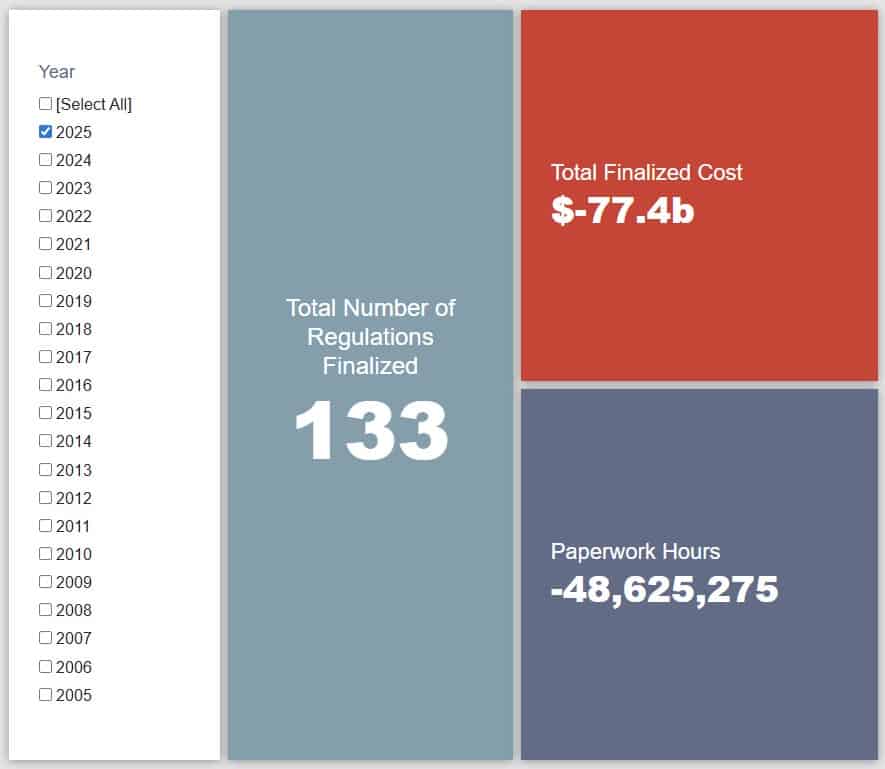
- 2025 Final Rule Costs: -$77.4 billion
- 2025 Proposed Rule Costs: -$624.6 billion
NOTABLE REGULATORY ACTIONS
As mentioned above, the most significant action of the week was the DHS proposed rule entitled “Establishing a Fixed Time Period of Admission and an Extension of Stay Procedure for Nonimmigrant Academic Students, Exchange Visitors, and Representatives of Foreign Information Media.” Specifically, the agency seeks to make the following changes:
Unlike most nonimmigrant classifications, which are admitted for a fixed time period, aliens in the F (academic student), J (exchange visitor), and most I (representatives of foreign information media) classifications, with limited exceptions, are currently admitted into the United States for the period of time that they are complying with the terms and conditions of their nonimmigrant classification (“duration of status”). The U.S. Department of Homeland Security proposes to amend its regulations by changing the admission period in the F, J, and I classifications from duration of status to an admission for a fixed time period.
Establishing this fixed period for the affected populations will require the covered individuals to affirmatively file more paperwork to certify that they meet the criteria for their respective visa statuses. DHS estimates that this will affect an average of 414,000 applicants each year going forward. The annual costs to these individuals and any related entities such as schools or employers comes to $392.4 million, or roughly $2.8 billion when extrapolated across a 10-year horizon. The additional total time burden for these now-covered filers will add up to roughly 1.6 million hours of paperwork each year. While this would seem to be a substantial cost addition to the Executive Order (EO) 14192 regulatory budget (most likely in the fiscal year 2026 iteration at this point) if finalized as proposed, do not expect to see this total in the administration’s eventual EO 14192 calculations since DHS is able to claim an exception “because it is being issued with respect to an immigration-related function of the United States.”
TRACKING TRUMP 2.0
There were no broad-based policy announcements from the White House last week that had any significant rulemaking implications.
With Congress out for its August recess, Congressional Review Act (CRA) news remained at a standstill. Nevertheless, the American Action Forum (AAF) CRA tracker provides a full survey of activity under the law thus far in 2025. As of today, members of the 119th Congress have introduced CRA resolutions of disapproval addressing 57 rulemakings across the Biden and Trump Administrations that collectively involve $138 billion in compliance costs. Of these, 16 have been passed into law, repealing a series of Biden Administration rules that had a combined $3 billion in associated compliance costs – roughly 2 percent of that potential $138 billion total. While the main window of CRA action has largely passed, there are still outstanding resolutions that could move legislatively. AAF will continue to monitor and update such developments as appropriate.
TOTAL BURDENS
Since January 1, the federal government has published $702 billion in total regulatory net cost savings (with $77.4 billion in cost savings from finalized rules) and 69.4 million hours of net annual paperwork cuts (with 48.6 million hours coming from final rules).