Week in Regulation
November 3, 2025
Sizable Costs Emerge Despite Shutdown
The month-long federal government shutdown had, unsurprisingly and as previously documented, led to dramatically lower amounts of rulemaking activity. This past week, however, saw a significant divergence from this trend due primarily to a Department of Homeland Security (DHS) rule on biometrics that involves more than half a billion dollars in new costs. Across all rulemakings, federal agencies published roughly $649.8 million in total costs but cut 169,999 paperwork burden hours.
REGULATORY TOPLINES
- Proposed Rules: 8
- Final Rules: 15
- 2025 Total Pages: 48,895
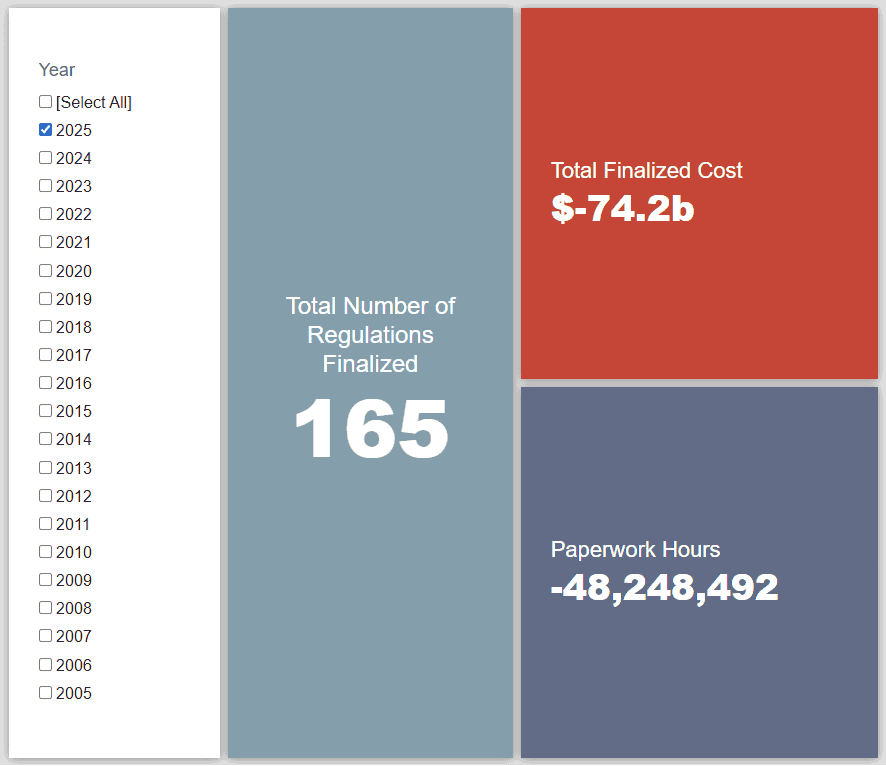
- 2025 Final Rule Costs: -$74.2 billion
- 2025 Proposed Rule Costs: -$627.9 billion
NOTABLE REGULATORY ACTIONS
The most consequential rulemaking of the week was the final rule from DHS regarding “Collection of Biometric Data From Aliens Upon Entry to and Departure From the United States.” Specifically, the action:
Amends Department of Homeland Security (DHS) regulations to provide that DHS may require all aliens to be photographed when entering or exiting the United States, and may require non-exempt aliens to provide other biometrics. The final rule also amends the regulations to remove the references to pilot programs and the port limitation to permit collection of biometrics from aliens departing from airports, land ports, seaports, or any other authorized point of departure.
While DHS estimates that such a biometric verification system may result in a certain amount of time savings, the costs involved in implementing the new protocols outpace estimated savings by a wide margin. The agency calculates total net costs of $587.3 million across a 10-year period using a 7-percent discount rate. Of course – as noted in the discussion of prior significant DHS rulemakings – one will not find this cost total included in any future Executive Order 14192 accounting from the administration since DHS is able to claim the “homeland security” exemption. This also represents another instance of the unique capacity DHS holds to largely continue rulemaking activity despite the lapse in appropriations.
TRACKING TRUMP 2.0
There were no broad-based regulatory policy announcements – such as the one discussed last week – from the White House this past week. There were, however, some developments over on Capitol Hill in terms of Congressional Review Act (CRA) legislation. Most notably, the Senate passed S.J. Res 80 by a vote of 52-45. The resolution would rescind a Biden-era Department of Interior (DOI) determination regarding the “National Petroleum Reserve in Alaska Integrated Activity Plan Record of Decision.” This “Record of Decision” in question is yet another instance of an agency action falling into the category “of a rule for purposes of CRA” based upon a Government Accountability Office determination despite not being a traditional Federal Register rulemaking notice.
In terms of new CRA items, a Senate-side resolution joined a previous House version in targeting another Biden-era DOI determination similar to the one above. Additionally, Senator Sheldon Whitehouse (D-RI) added to his growing portfolio of resolutions of disapproval filed against Trump Administration rulemakings with S.J Res. 92 and S.J Res. 93 that seek to rescind rules on “Rescinding Regulations Regarding Management Systems Pertaining to the Fish and Wildlife Service and the Refuge Roads Program” and “Restoration of Names That Honor American Greatness; Gulf of America,” respectively.
The American Action Forum (AAF) CRA tracker provides a full survey of activity under the law thus far in 2025. As of today, members of the 119th Congress have introduced CRA resolutions of disapproval addressing 68 rulemakings across the Biden and Trump Administrations that collectively involve $138 billion in compliance costs. Of these, 16 have been passed into law, repealing a series of Biden Administration rules that had a combined $3 billion in associated compliance costs – roughly 2 percent of that potential $138 billion total. While the main window of CRA action has largely passed, there are still outstanding resolutions that could move legislatively. AAF will continue to monitor and update such developments as appropriate.
TOTAL BURDENS
Since January 1, the federal government has published $702.1 billion in total regulatory net cost savings (with $74.2 billion in cost savings from finalized rules) and 69.7 million hours of net annual paperwork cuts (with 48.2 million hours coming from final rules).